The Union Solidarity and Development Party is already campaigning for the junta’s upcoming election, leveraging its military connections to gain an unfair advantage and leaving other parties struggling to compete.
By FRONTIER
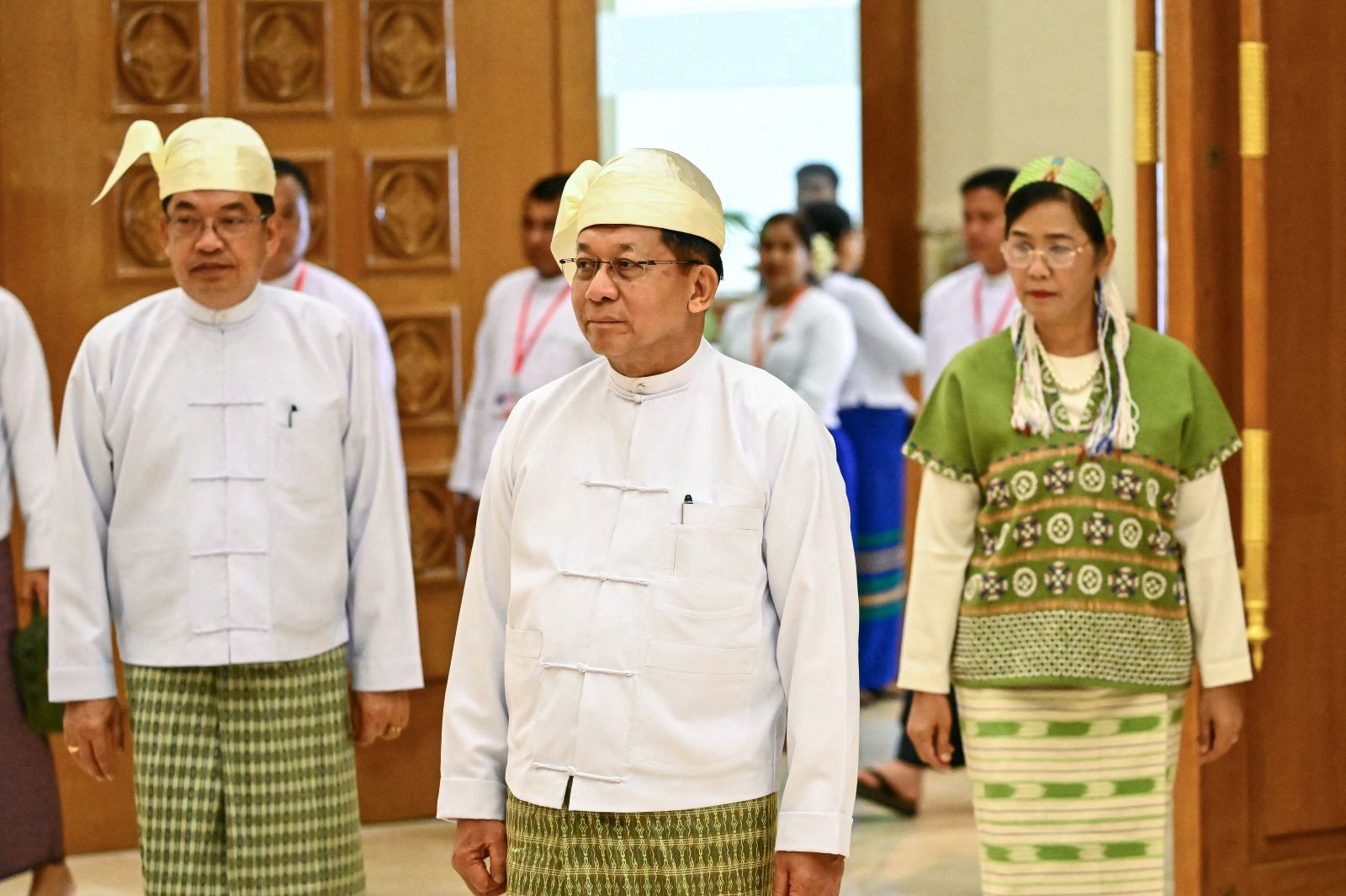
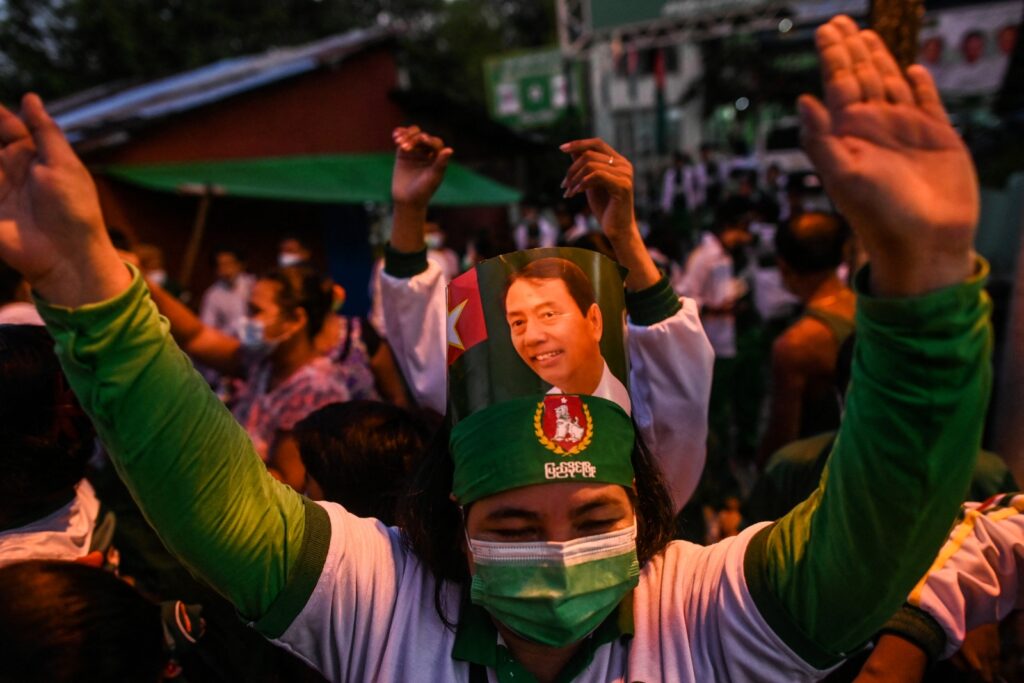
Residents of Seikgyikanaungto Township in Yangon have become accustomed to seeing groups of men in plain white shirts and green longyis visiting poor neighbourhoods, where they engage with locals and make donations.
They are members of the Union Solidarity and Development Party, the electoral arm of the Myanmar military. read more
“Last week, members from the party’s regional office came to our ward and donated money to the elderly,” said Ma Thi Thi, a resident of the township, asking Frontier not to use her real name for security reasons. “They never used to come and donate like this, but now they’re just showing up. It must be to campaign for votes.”
Seikgyikanaungto is one of 33 townships in the urban zone administered by the Yangon City Development Committee. Located across the Yangon River from the city’s central business district, it is an under-developed area primarily inhabited by poor and working-class residents.
Seikgyikanaungto is also the constituency of U Khin Yi, the current chair of the USDP. In the 2020 general election, he lost his attempt to win a parliamentary seat to U Tin Tun Naing, the candidate for the National League for Democracy. With the results of that election annulled by the 2021 military coup, Tin Tun Naing now serves as the National Unity Government’s minister of planning and finance.
The Union Election Commission announced on August 18 that the first phase of polling for the junta’s election would be held on December 28, with subsequent rounds of voting slated for January. Thi Thi said that since that announcement, signs of intensified election activity have become evident in Yangon and Ayeyarwady regions, which are largely under junta control.
While it’s common to see political parties engaging with the public before an election, the situation in Myanmar this year is unusual because only the USDP is visible.
“So far, apart from the USDP, no other political parties have visited my ward,” Thi Thi said.
Campaign date set
On October 16, the UEC announced that political parties contesting the election will be given 60 days to campaign. Parties will be able to campaign from 6am on October 28 until just before midnight on December 26.
Previously, the UEC had said parties were allowed to conduct planning and organising activities starting on August 18, but were not allowed to campaign in public until the timeline was announced.
However, the USDP’s public campaign activities have been apparent in Seikgyikanaungto and other townships for the past two months. Although other parties feel this is unfair, none have made formal objections over fears that they might be disbanded for complaining.
A member of the People’s Party from Yangon’s West Hlaing Tharyar Township told Frontier that he frequently sees USDP members engaging with potential voters, as well as donating to monasteries and poor families.
“Even though they don’t tell people to vote for them, the donations are a form of campaigning,” he said, adding, “The People’s Party won’t campaign until the UEC officially allows it.”
The PP was formed in 2018 by former 88 Generation leader U Ko Ko Gyi. The party failed to win any seats in the 2020 election despite campaigning throughout the country.
In the wake of the coup, the PP re-registered with the UEC in February this year to contest the upcoming election at the national level. As of September 23, the PP has registered 512 candidates with the UEC.
Daw Sandar Min, who plans to run in the election as an independent candidate in Yangon’s Latha Township, echoed the PP member’s sentiments, saying the UEC is favouring parties close to the military. She said Khin Yi is one of the very few candidates who has been able to campaign openly.
“Others can’t campaign yet. I’ll only start when it’s 60 days before the election, as designated by the UEC,” she told Frontier. “The election is ultimately decided by the votes of the people. No matter how much of a head start they get, they won’t necessarily win.”
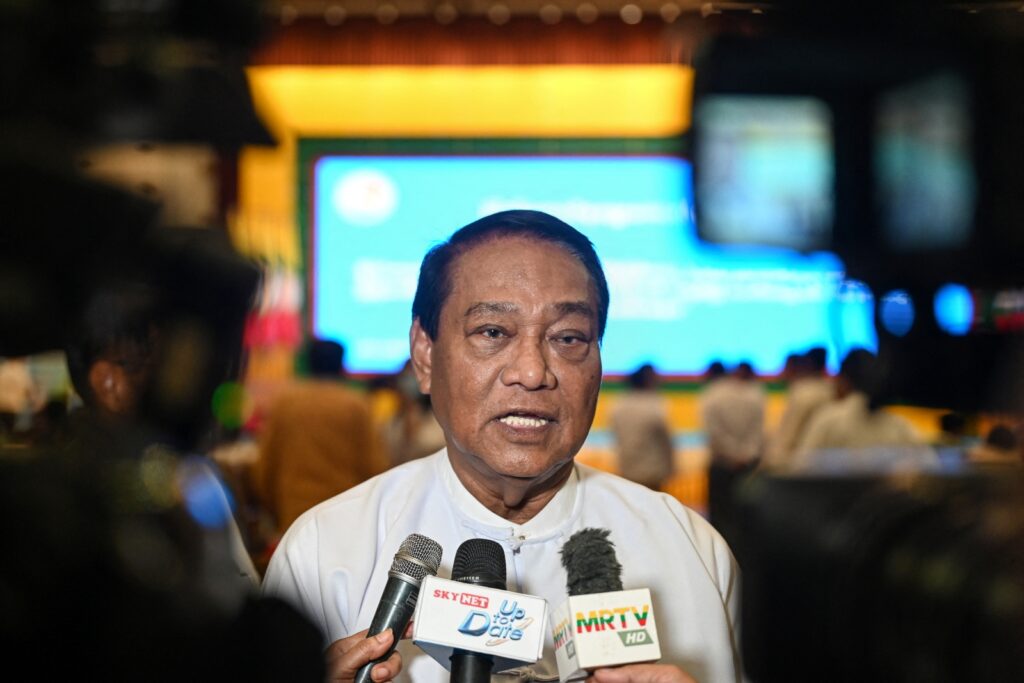
Sandar Min said Khin Yi regularly holds meetings with the public – including farmers, students and celebrities – which are then promoted on the USDP’s Facebook page. The page also posts Khin Yi’s weekly videos in which he directly addresses the public.
“Instead of simply echoing slogans that are only good for hearing, we are ready to deliver concrete, measurable results within a set timeframe,” Khin Yi said in a video posted on September 28. “We have fully qualified personnel to implement these strategies.”
Despite this overt campaigning, the UEC appears to be turning a blind eye to these activities. Frontier reached out to the UEC and USDP for comment but received no response.
Parties disbanded
Sandar Min is a former NLD member who won the lower house seat for Nay Pyi Taw’s Zabuthiri Township in the 2012 by-election, before winning a seat representing Seikgyikanaungto in the 2015 poll. She did not contest in 2020 but served as an organiser for the NLD’s election campaign in Nay Pyi Taw.
She was expelled from the NLD in 2023 for supporting the junta’s upcoming election, among other reasons. In August she joined the National Democratic Force, which had been formed by former NLD members who broke away to participate in the 2010 general election after the NLD announced it was boycotting that poll.
This year, many former NLD members, including Sandar Min, joined the NDF to take part in the junta election. The party said that about 50 former NLD members who had won in previous polls signed on as candidates.
However, the NDF was among four political parties disbanded by the UEC on September 9 for ostensibly failing to meet requirements under the regime’s Political Parties Registration Law enacted on January 23.
Sandar Min said she could not understand the UEC’s decision. According to the registration law, national parties need at least 50,000 members to be accepted, but Sandar Min said the NDF submitted a list of over 88,000 members.
“We asked the UEC why they said we didn’t meet the required number of members, but we’ve had no response,” she said.
She has since given up on the NDF but not on the election. Now registered as an independent candidate, she urges the public to vote because she worries that only USDP supporters will show up at polling stations.
“If the people don’t vote, we’ll lose to the USDP. People need to understand that,” she said.
A political analyst and former lawmaker, who defeated his rival from the USDP in the 2010 election, said that with the absence of the NLD there was already low interest in the upcoming election. The dissolution of the NDF, he said, could result in public interest dropping to zero.
“Those who vote will mostly be USDP supporters. The smaller parties will effectively act as supporting cast or fillers, performing only to make the USDP appear as a government that came to power through a legitimate election,” he told Frontier, requesting anonymity for security reasons.
“The plot is already written, the ending is already known. In this scenario, the other parties are essentially playing the role of clowns or supporting actors.”
USDP packs local administrations
According to the UEC, as of September 23 a total of 4,963 candidates from six national-level political parties, 51 from regional-level parties and 95 independent candidates had submitted their names to contest parliamentary seats.
The USDP had registered the highest number of candidates, submitting a list of 1,018. That’s almost double the number of the National Unity Party, which is fielding the second-highest number of contenders.
While the UEC has done nothing to curtail the USDP’s early campaigning, the party is also receiving additional advantages, including the appointment of USDP members as ward and village administrators by the junta. Since the coup, these administrators have been instrumental in implementing the junta’s policies, including conscription.
From 2011 to 2020, during the U Thein Sein and NLD governments, ward and village administrators were locals elected by their communities. However, after the coup they were replaced with USDP members by Township Administration Councils formed by the regime. Many of the elected administrators who were replaced joined the Civil Disobedience Movement in protest against the coup.
Ko Zaw Win, a resident of Danubyu Township in Ayeyarwady who asked to be identified by a pseudonym for his protection, said that when the elected administrator of his village resigned in February 2021, the town council appointed a USDP member to replace him.
With the election approaching, it appears the USDP is exploiting his position.
“Even without direct campaigning by party members, [the local USDP candidate] is actively promoting the benefits of a USDP victory throughout the village,” Zaw Win said.
A USDP administrator from another village in Danubyu, who was appointed after the coup, told Frontier that it is now regime policy to appoint only USDP members as administrators.
“From what I know, they planned to appoint only USDP party members,” he said. “In our township, only USDP members have become administrators since the coup. This hasn’t been officially stated within the party, but the upper level of the party probably knows about this.”
Some administrators elected before the coup were able to temporarily hold onto their positions by maintaining good relations with junta officials. One of them was U Min Min Oo, the administrator of Mayangone Township’s Ward 4 in Yangon, who was elected in 2016.
Min Min Oo quickly built a close relationship with the military, implementing the regime’s orders while cultivating good relations with the local residents.
A 33-year-old resident of the ward said that Min Min Oo is a “cunning person”.
“He’s the type who can get along with any government that comes to power. When the junta began conscription, he bought people from outside the ward instead of taking residents from his own neighbourhood,” the resident said.
“However, in mid-2024 the township team dismissed him without giving a reason. Then they appointed a USDP member from the ward to replace him. His name is Myo Oo. But the residents prefer Min Min Oo over him.”
A source from the Yangon city branch of the junta’s General Administration Department, which oversees ward and village administrators, confirmed to Frontier that by 2024 the junta had completed the replacement of the administrators throughout the country with USDP members. He declined to provide the rationale.
However, it is clear that these administrators are now actively campaigning for the USDP.
Zaw Win from Danubyu said that the administrator of his village is pressuring residents to vote for the USDP in the election, using a mix of gentle persuasion and outright threats.
“During the voting demonstration last month, he demanded one person from every household attend. He threatened to ‘take action’ if they didn’t come,” he said.
“At those events, he says that if the USDP wins the election, people won’t have to serve in the military. Given the public’s fear of conscription, many people believe what he says.”
Back in Seikgyikanaungto, Thi Thi is under no illusions about the junta’s poll.
“We know the election is a sham,” she said. “During the last election, public interest was extremely high. I rushed to vote at the polling station. But this time, I have no plan to even check the voter list.”
Another resident in the same ward as Thi Thi, who works as a housemaid and supports four dependents, said that when the USDP comes to donate, she doesn’t refuse.
“There are so many poor people in my ward, and K20,000 [about US$4.5 at the market rate] or K30,000 can buy about four pyi [8.5 kilogrammes] of rice, which can feed my family for three or four days,” she explained. “I have no interest in voting. Our attitude is, ‘If they give, we’ll take. If they speak, we’ll listen. But casting a vote is up to us’.”