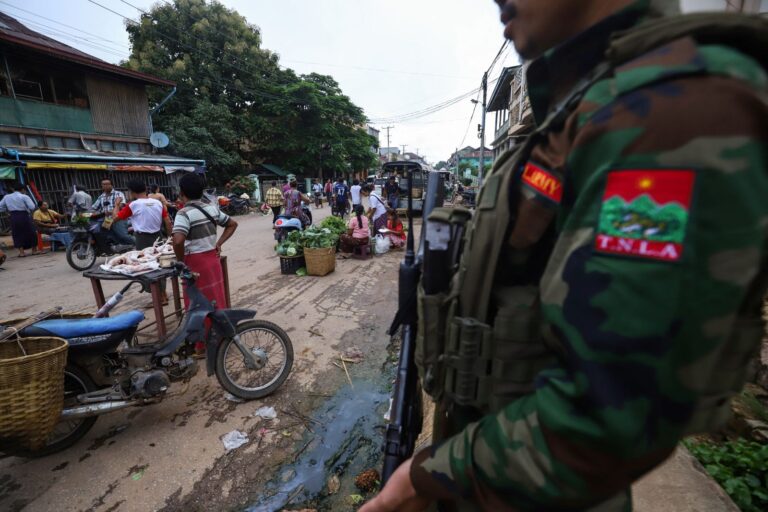
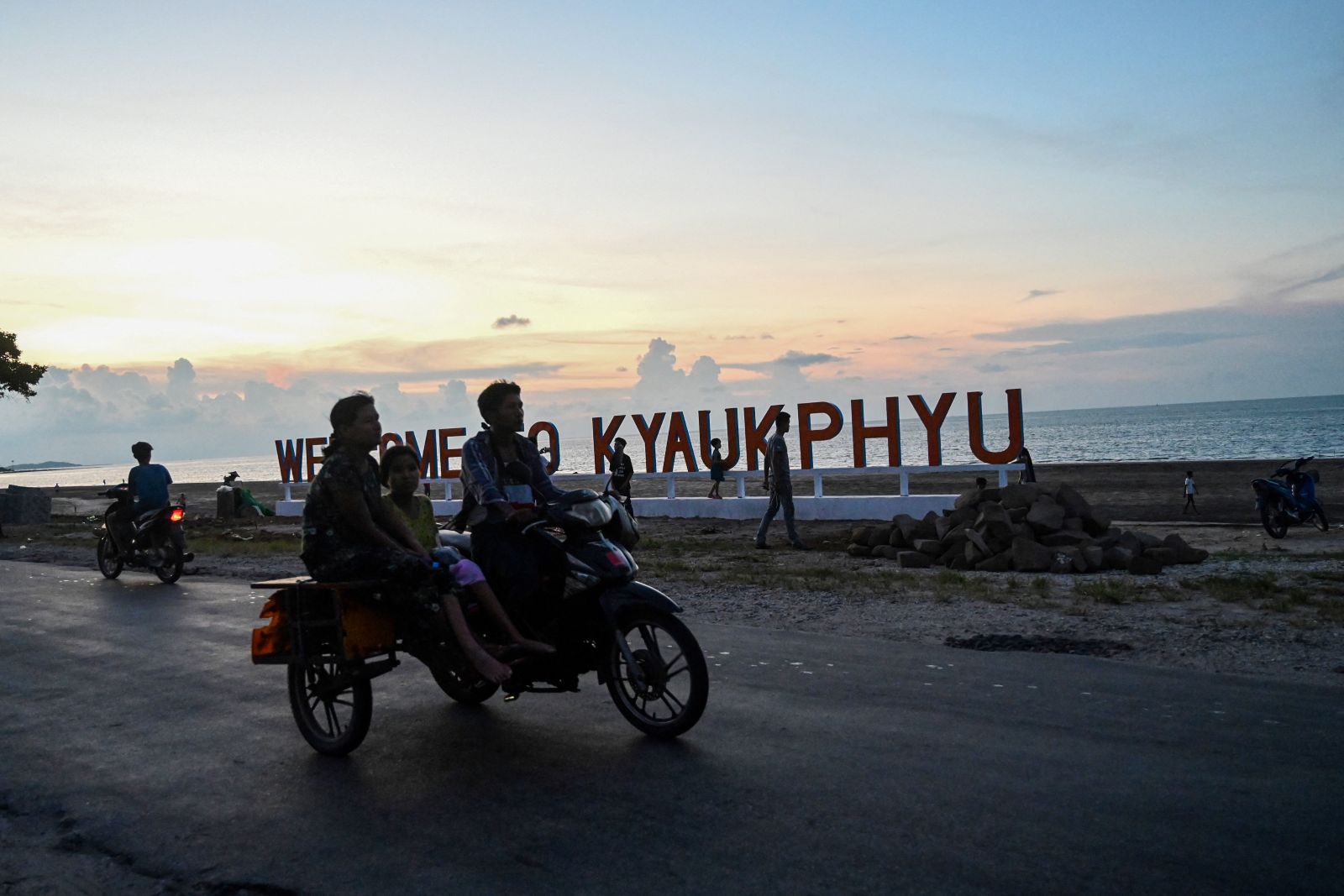
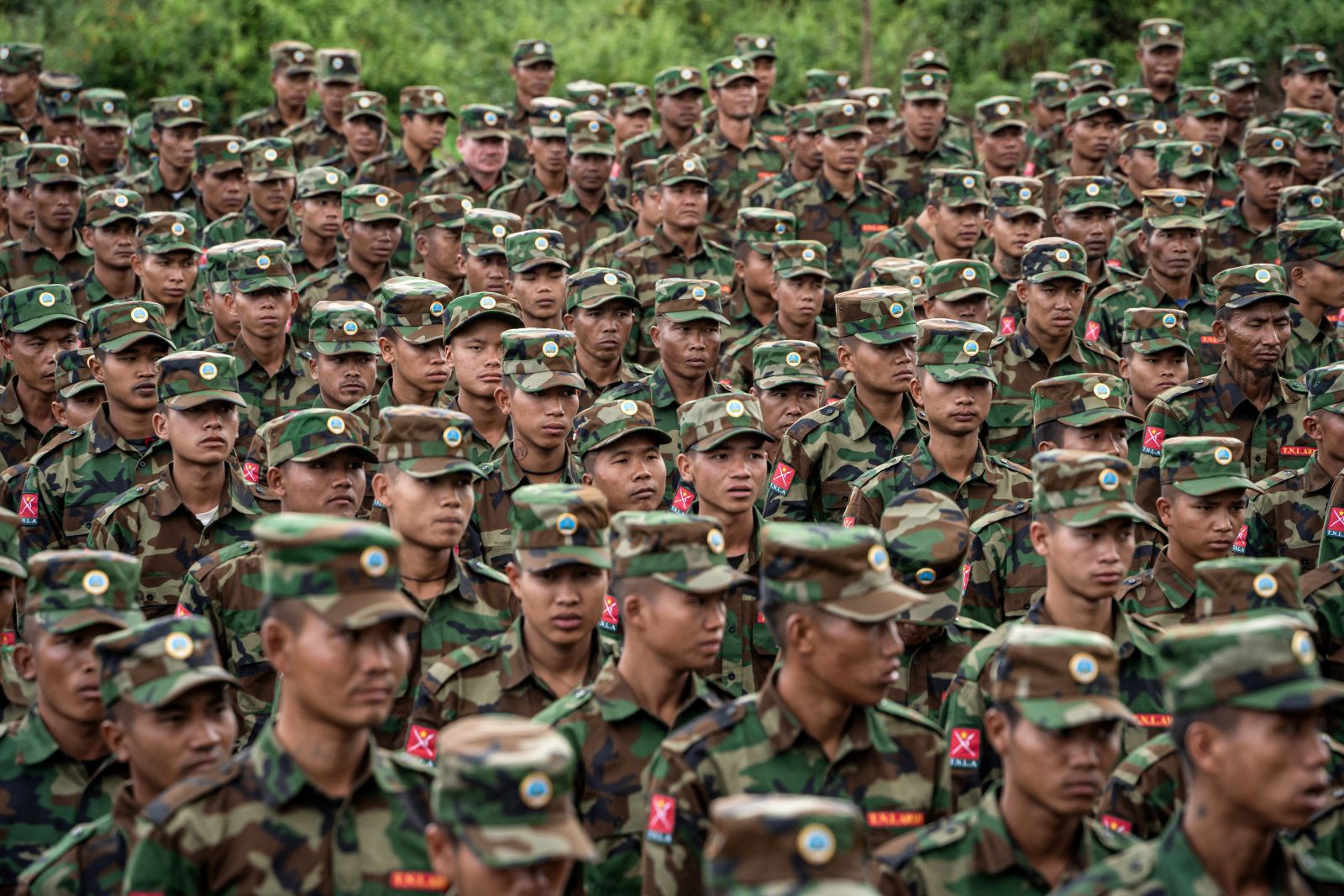
Nearly 10 months after the Kachin Independence Army seized Pangwa town in Kachin State, the lucrative industry is coming under increasing pressure to resume.
By EMILY FISHBEIN and JAUMAN NAW | FRONTIER
This article was written with support from the Pulitzer Center’s Rainforest Investigations Network.
Over the past decade, Myanmar has seen a boom in rare earth mining tied to the global transition to renewable energy sources. In a mountainous region on Kachin State’s border with China’s Yunnan province, Chinese investors have partnered with local warlords to extract billions of dollars’ worth of elements used in the production of electric vehicles, wind turbines and other advanced technologies.
China also holds deposits of heavy rare earths – a subset of the elements particularly found in Myanmar – and once mined most of the global supply domestically. But as the mining’s adverse environmental impacts became increasingly apparent, Beijing tightened regulations beginning around 2010, and many investors turned to Myanmar.
The 2021 military coup in Myanmar triggered a resource grab across the country, and rare earth mining accelerated in Kachin. Most of its rare earth mines are located near the towns of Pangwa and Chipwi, in a territory on the border with Yunnan province which was previously known as Kachin Special Region 1. It was controlled by a Border Guard Force and militia affiliated with the military-aligned warlord Zahkung Ting Ying until late last year, when the Kachin Independence Army seized it as part of a wider offensive against the junta and its allies.
The fighting, as well as border gate closures initiated by China, effectively brought rare earth mining in the territory to a standstill. Now, amid a tense trade war with China, the administration of United States President Donald Trump is hearing proposals for altering longstanding US policy towards Myanmar in order to secure access to Kachin’s rare earths, according to a Reuters article published on July 29. Meanwhile, the mining has yet to fully resume in the Pangwa area.

‘Behind closed doors’
Research published in September last year by Patrick Meehan of the University of Warwick in the United Kingdom and Dan Seng Lawn of the Myanmar-based Kachinland Research Centre found that all rare earth mining in northern Myanmar takes place in areas of armed conflict, where local armed groups have a long history of autonomy from central authorities.
Typically, Chinese companies pay a lump sum to the group controlling a certain area for permission to mine, according to the report. It found that in return, armed groups offer land rights as well as security to mining companies and permission for their workers to stay in their territory. Companies then bring in their own technicians and equipment.
In some cases, companies also form joint ventures with armed groups or businesspeople linked to them, offering an upfront payment and a share of the revenue in return for mining rights, in arrangements typically established “behind closed doors without any kind of public consultation”, the report said.
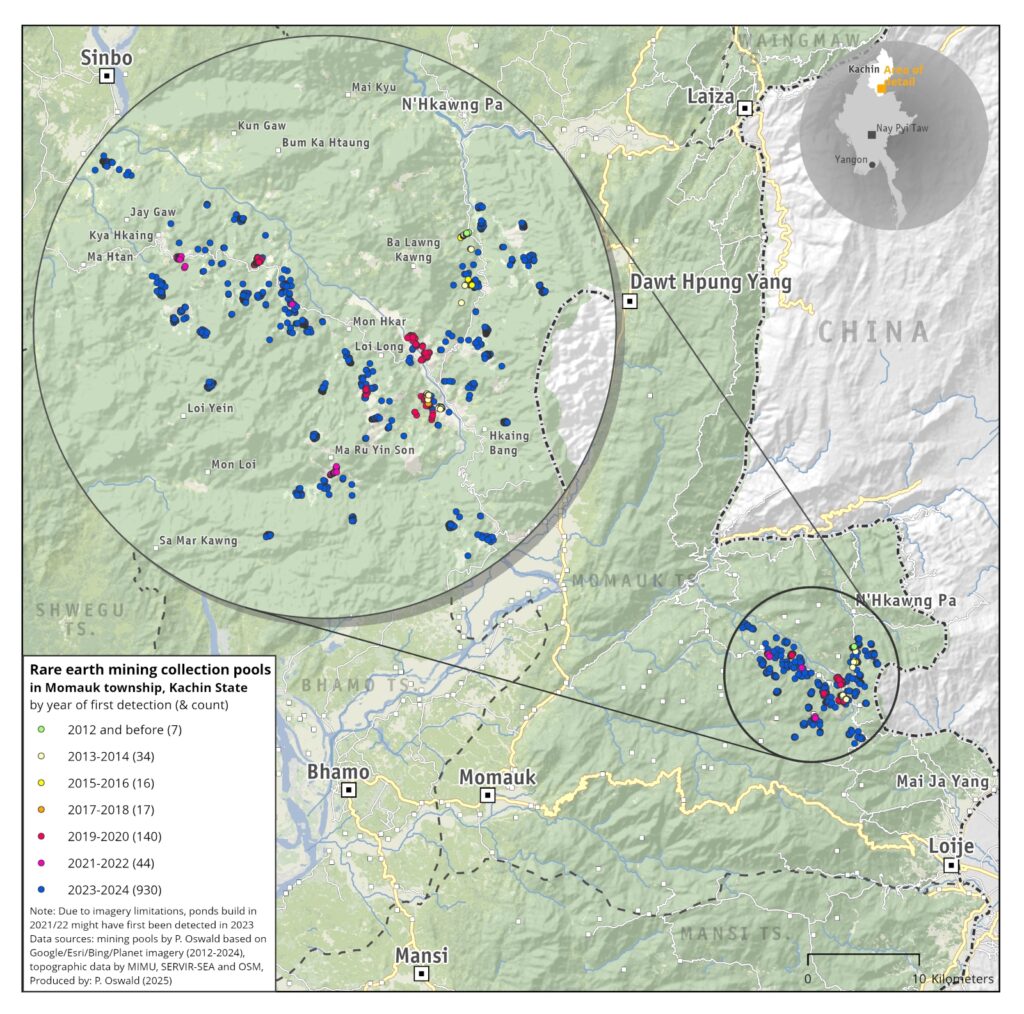
These practices make it difficult to follow any paper trail, but satellite imagery helps to reveal the scale. By the end of 2023, it showed more than 300 rare earth mining sites in Kachin Special Region 1, as well as more than 40 in territory controlled by the KIA’s administrative counterpart, the Kachin Independence Organization, according to the environmental watchdog Global Witness.
Chinese customs data shows further details about the industry. Imports from Myanmar of rare earth oxide “concentrates”, or mixes of rare earth compounds containing both light and heavy rare earths, more than quadrupled between 2017 and 2023, according to data accessed by the critical minerals strategy firm Adamas Intelligence.

Ryan Castilloux, the firm’s founder and managing director, said tracing heavy rare earths from mining to market is virtually impossible because supplies are mixed during the refining process. Still, with China holding nearly all of the world’s heavy rare earth refineries, it is likely that between half and two-thirds of the world’s heavy rare earth supply originates in Myanmar, according to Castilloux. This data, he added, makes it highly probable that globally strategic products, including military and aerospace technologies, electric vehicle motors and wind power generators, contain rare earths mined in Myanmar. “If you’re buying from China, you’re contributing to what’s happening in Myanmar,” he said.
A global ‘supply shock’
When the KIA seized Pangwa in October last year, China, which maintains close ties to the Myanmar junta, closed its border gates into KIO-controlled territory. Chinese customs data shows that rare earth oxide concentrate imports from Myanmar dropped by more than 80 percent, causing what Castilloux described as a “supply shock” to the global industry.
Pressure somewhat eased in March, when the KIO began allowing companies to export their existing rare earth inventory while charging a tax of 35,000 Chinese yuan per tonne (approx US$4,800), according to an unverified memo sent by the KIO to miners and cited by Reuters. Chinese customs data accessed by Adamas Intelligence shows that imports of rare earth oxide concentrates from Myanmar increased tenfold from March to April of 2025, and that by May, import volumes were similar to last year. Still, Castilloux cautioned that these volumes could drop after inventory runs out.

To assess the situation on the ground, nine members of the Kachin Resources Concern Group, a civil society organisation established after the coup, travelled to the territory in April with permission from the KIO. Their report, which they did not release publicly but shared with the authors of this article, found that some rare earth mining was happening in the Pangwa area, but most operations had stopped.
The KIO, said the report, was not only taxing rare earth exports at 35,000 Chinese yuan per tonne, but also imposing a tax of two out of every 10 tonnes of rare earths crossing the border – a rate which seems to imply that the KIO may be selling rare earths directly to China itself.
The report also found that a Chinese rare earth mining association called Shitu Shewei, Shewei Huisheng was mediating land and wage disputes between locals and Chinese businesspeople in the territory. The association, said the report, maintained an office in Tengchong town, Yunnan province, and had a “close relationship” with Chinese state-owned enterprises.
The name Shitu Shewei appears to refer to the Association of China Rare Earth Industry, a commercial association headed by Chinese state-owned rare earth companies. Its president, Ao Hong, also serves as chairman of the China Rare Earth Group, a major state-owned enterprise. Frontier was unable to independently confirm whether Chinese state-linked groups had a presence in the Pangwa area.
Contract negotiations
In a phone interview on July 22, the KIO’s information officer Colonel Naw Bu told Frontier he did not have details about the business enterprises involved in rare earth mining in KIO-controlled territory or the KIO’s taxation policy within the industry because this information was held by the organisation’s economics department.
He was, however, able to speak about the situation in the Pangwa area. Before the mining could resume, said Naw Bu, the KIO needed to negotiate with companies which had previously been mining through agreements with Zahkung Ting Ying’s groups.
“After the KIO took control of the region, Chinese companies could no longer continue operations unless they reached new agreements with the KIO,” he said. “Some negotiations were held between the KIO and Chinese companies, which delayed the reopening of the gates.”
According to Naw Bu, taxation was a key issue. “The Chinese companies claimed that they had already paid taxes to Zahkung Ting Ying’s group,” he said. “They claimed that to continue operations under KIO authority, they would have had to pay tax twice, which would affect their business. Thus, they requested for the KIO to reduce tax rates, and the KIO allowed them to continue operating with these reduced rates.”
He added that border gates from KIO-controlled territory had unofficially reopened earlier this year to allow for some exports to China, but imports into Kachin remained limited and border trade had not formally resumed. “Rare earth mining operations are continuing, but only with the same companies that were involved before,” he said. “No new companies have been permitted, and no additional licences have been issued. Therefore, vehicle movements carrying rare earths are limited to those original companies.”

Political factors
Some reports have suggested that political factors are also behind delays in the full resumption of the industry. Since the coup, China has repeatedly pressured ethnic armed organisations to cease fighting against the junta or withdraw from territory along its border. While some groups have held their ground, others have bowed to the pressure.
The KIA, one of Myanmar’s most well-established ethnic armies, has been supporting anti-junta groups since the coup, while clashing heavily with junta forces. It launched a new offensive in March last year, and has since taken significant territory from the regime, while waging a fierce battle for control over Kachin’s second-largest town of Bhamo.
Reuters reported in July that China was pushing the KIA to halt its Bhamo offensive as a condition for buying rare earths from KIO-controlled territory. Frontier was unable to independently confirm this information, which Naw Bu described as “not entirely true”.
“During discussions between the Chinese government, Chinese companies and the KIO, the main points raised were requests to reduce taxation and to provide protection for Chinese companies,” he told Frontier. “So far, there have been no threats or indications that China will stop buying rare earths or halt business operations in KIO-controlled areas.”
Sources familiar with the local business and political context told Frontier they believed the KIO had significant leverage when negotiating with China. A businessman in Kachin, speaking on condition of anonymity due to security concerns, said the ethnic armed group’s military strength, combined with its support from the public and its expanded territory, gave it “more muscle to flex” than in the past.
A civil society worker with the Kachin Resources Concern Group also said the KIO was likely to hold its ground during ongoing discussions. “The KIO can still survive without rare earth mining. It can still survive with jade mining, gold mining and other ways,” he told Frontier, also speaking on condition of anonymity. “The KIO is resisting, and also not very much rushing to make an agreement with China.”
Diversifying markets
In the meantime, China is working to diversify its markets into Laos and other countries, according to Castilloux of Adamas Intelligence. He said the KIA takeover of Kachin Special Region 1 may have accelerated this trend, but the volatile situation in Myanmar since the coup was already putting pressure on the industry.
Rare earth mining is also expanding in Shan State. In May, the Shan Human Rights Foundation identified satellite imagery showing sites near the Thai border, in territory jointly controlled by the junta and the United Wa State Army. The mines, it said, emerged in mid-2023 and mid-2024 in eastern Shan’s Mong Hsat Township. A second report published in June identified 26 rare earth mines in UWSA territory near the town of Mong Bawk on Shan’s border with China.
The UWSA, which maintains two autonomous territories on Shan’s borders with China and Thailand, is Myanmar’s most powerful ethnic armed organisation. It has close ties to China, and has kept a stance of noninterference in Myanmar’s post-coup uprising. One of the world’s largest tin producers, the UWSA is also a major player in Kachin’s lucrative jade mines, and in recent years has invested in rare earth mining in other parts of KIO-controlled territory.
As China diversifies its rare earth mining investments, the KIO also seems to be trying to reduce its dependence on China. According to the July 29 Reuters article, there have been multiple discussions between US and KIO officials through interlocutors in recent months regarding access to rare earths in Kachin. Citing anonymous sources familiar with the context, however, Reuters reported that conversations in the White House on the topic were still “exploratory” and “in early stages”.
Reuters also reported in March that KIO officials met with representatives from an Indian state-run mining and refining firm. But with India lacking rare earth processing facilities or the chemicals needed to mine them, the KIO is likely to remain reliant on China for the time being, a Kachin political analyst told Frontier, also speaking on condition of anonymity. “The KIO tries to use the minerals as strategic bargaining chips for politics, but the KIO doesn’t have many alternatives,” he said. “If they want to sell, if they want capital investment, only Chinese companies can guarantee that.”

Challenges ahead
When the mining does resume, a lot is at stake for the KIO. In the years leading up to the coup, it engaged in public consultations towards formalising a resource governance policy, but the policy was never published. The KIO’s participation in the post-coup uprising has brought new funding demands, and while public support for its political aims has surged, it has also faced rising pressure to be more transparent and accountable in its resource governance practices.
These issues came to a head in 2023, when KIO chairman N’Ban La cancelled rare earth mining plans in Kachin’s Mansi Township in response to public protests. Still, the KIO continued to allow rare earth mining in other parts of its territory including the Hpare area of Chipwi Township, where it cracked down on protests in early 2024.
It appears to be taking a different approach in the Pangwa area, where it has pledged to manage rare earth mining with consideration for the environment and the public. Naw Bu told Frontier on July 22 that the KIO has enacted a policy on resource management, mining, and environmental conservation and protection, including for rare earth mining. The policy, he said, covers licensing and taxation procedures, and includes a framework for how companies should interact with local communities.
But he added that the policy rests with the KIO’s economics department and is not publicly available. “The department presents the policy directly to companies,” he said. “If the companies agree to the terms, they may be granted permission to operate, or they may enter into negotiations and reach an agreement with the KIO.”
Sources interviewed by Frontier hoped the KIO would manage rare earth mining in its new territory with consideration for the public interest, but expressed a degree of uncertainty. “The KIO’s legitimacy is built around the Kachin public,” said the local businessman. “In order to proceed to full scale rare earth mining operations they will at least try to reach a kind of public consensus or make it look like the public has agreed.”
The Kachin political analyst said the KIO could also face pressure from within if its leaders were perceived as taking an unfair share of the rare earth wealth. “How the KIO manages rare earths … will have a lot of impact on the KIO political leadership and public support,” he said.
Gaining the trust of communities in the former Special Region could also be a particular challenge. While the KIO claims inclusivity, it has long faced accusations of favouring ethnic Jinghpaw people, one of several Kachin groups. Like other military-aligned leaders in Kachin, Zahkung Ting Ying and his allies claimed to offer protection to the area’s non-Jinghpaw communities from the KIO.
An ethnic Lhaovo from the Pangwa area, who now lives in another part of Myanmar, told Frontier she worried that ethnic tensions could increase over matters including the KIO’s ongoing use of Jinghpaw as the lingua franca. “We, Lhaovo and Lachid, are also ethnic [Kachin] people and [the KIO should] not force or trick us using Jingphaw language,” she said. “Jingphaw are [not] the only ethnic group who fought during the battle in that region. Many Lhaovo, Lachid and Ngochan lost their lives too.”
Naw Bu emphasised that the KIO was not only focusing on rare earth mining in the territory, but also on setting up its administration and public services. “We are currently doing our best to support people’s basic needs, such as education, transportation and healthcare,” he said, adding that the KIO was also carrying out anti-drug campaigns. “Our current focus is on the development and well-being of the local people living in these regions.”
So far, Zahkung Ting Ying’s groups have not launched any serious counter-attacks, but they are not entirely out of the picture. In June, a Facebook account seemingly associated with Zahkung Ting Ying’s oldest son, Ying Sau, posted two video clips from the jungle, with captions suggesting that preparations to take back the former Special Region 1 by force were underway.
According to the analyst, even if the BGF and its partners wanted to retake the territory, they would be unlikely to pose a significant threat to the KIA without the junta’s support. To pacify them and dissuade them from seeking this support, he said, the KIO may offer them a share of the rare earth wealth. “To really keep the area stable, even for the KIO to implement their own administration and keep these mining activities going, I think they would try to find some kind of agreement with Zahkung Ting Ying’s friends,” he said.
Regardless of who controls the territory, local sources pointed to China as the biggest winner of Kachin’s rare earth mining boom. “China has been abusing the environment of Kachin State,” said a civil society worker and environmental activist. “It is like stealing something when the internal situation of its neighbour is unstable.”
Additional reporting by HpanJa Brang