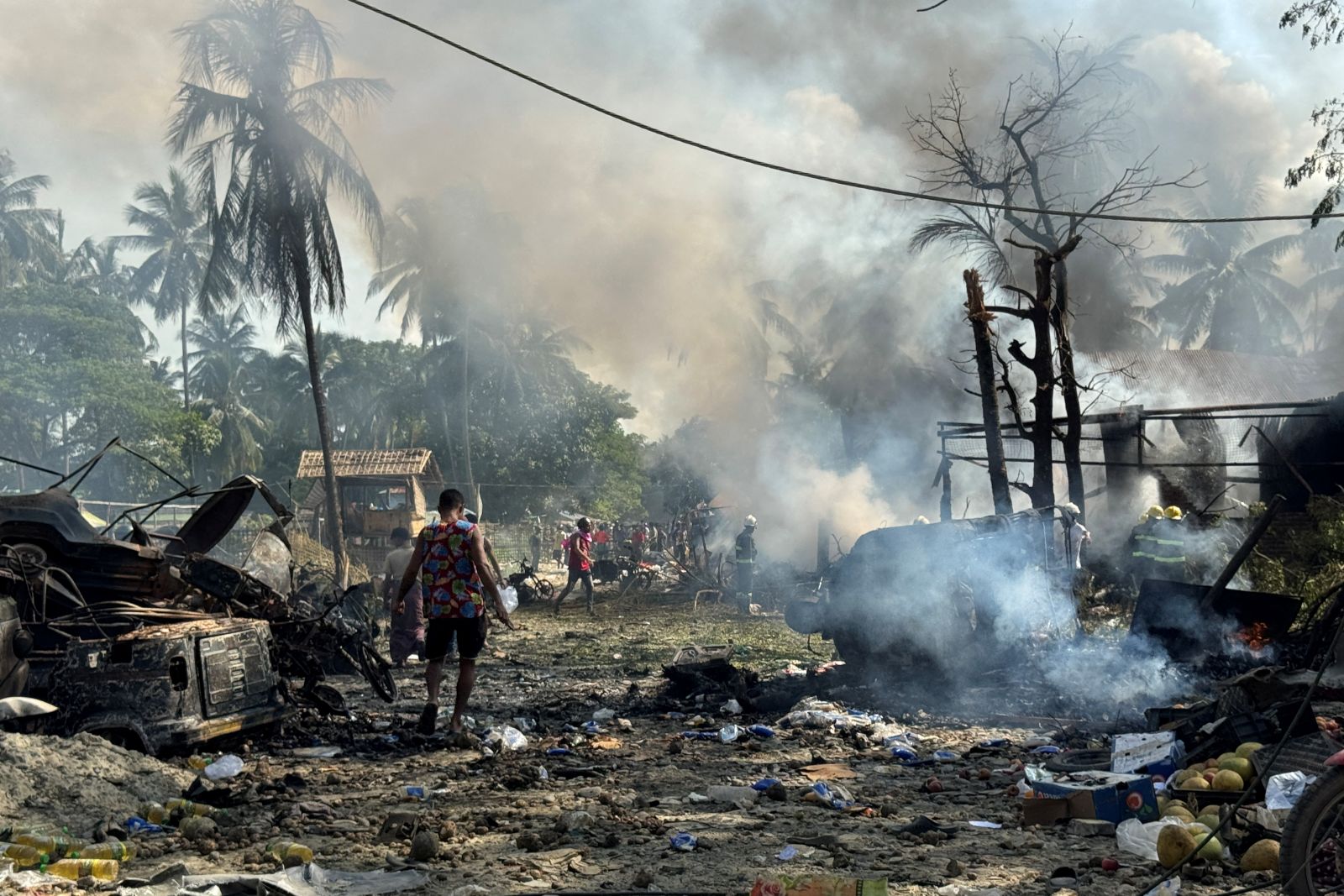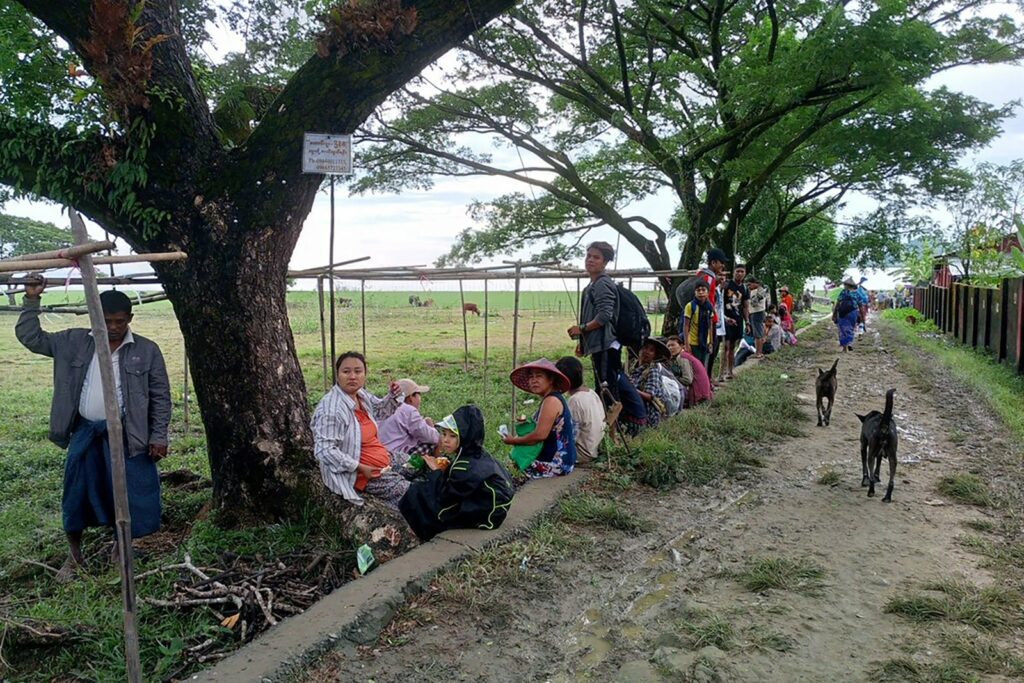
The war between the Arakan Army and the military in Rakhine, and crippling trade blockades imposed by the junta, have destroyed the state’s economy, causing many of its inhabitants to beg in the streets to feed themselves and their families.
By KHAING LYNN | FRONTIER
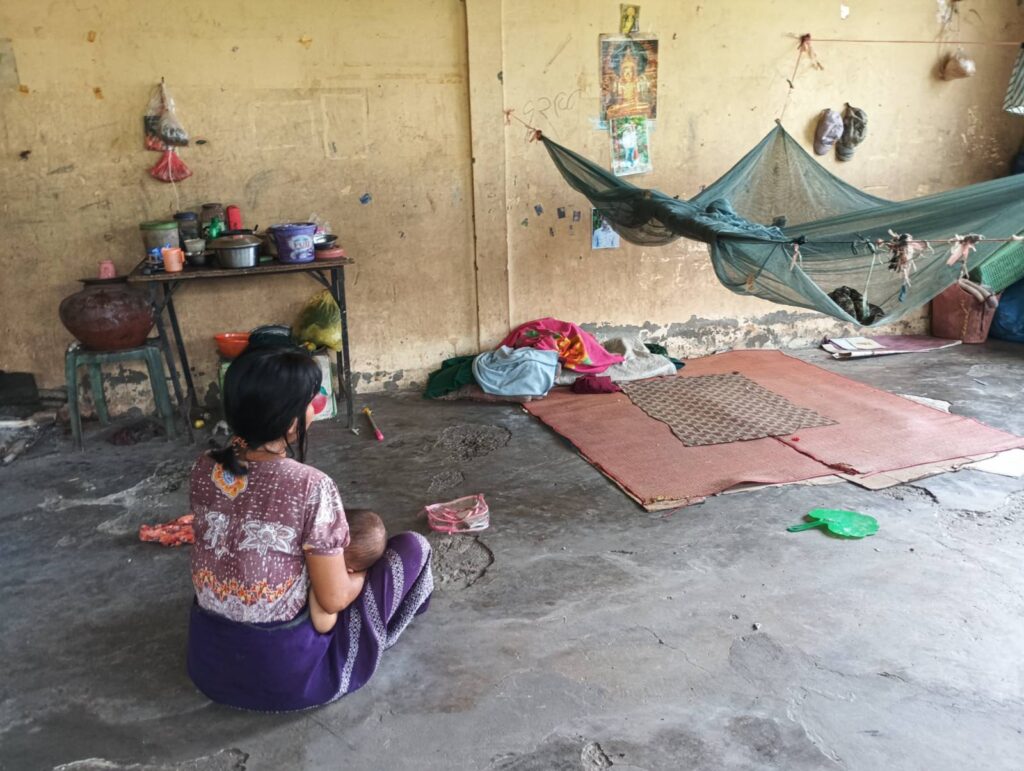
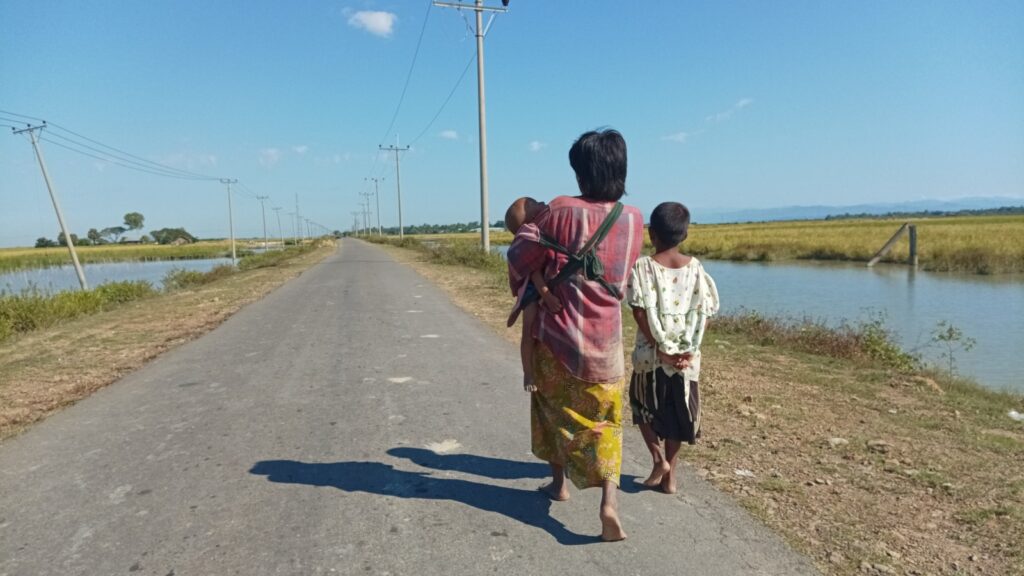
Every day, Ma Than walks barefoot through the streets of Myebon town, carrying her 18-month-old daughter in her arms as she begs from house to house for something to eat.
The 37-year-old woman lives in a camp for internally displaced people on the outskirts of the town, located in northern Rakhine State. Unable to work amid the conflict and economic collapse engulfing Rakhine, and lacking any support from relatives or charities, she has been pushed to beg to survive.
“When I beg, some people wave their hands and yell at me to go away,” Ma Than told Frontier, using a pseudonym to protect her identity. “But I keep doing it when I think of my daughter, because I know that I can eat only if I beg, and that’s the only way I can breastfeed my baby. I had never done this in my life. I want to cry when I talk about begging.”
Originally from Myebon Township, Ma Than lived most of her life in the coastal village of Gyeiktaw, in southern Rakhine’s Thandwe Township, where she married her husband seven years ago. She made a living there sorting and drying fish, while her husband worked on a fishing boat. They were far from rich, but could make a decent living.
Their peaceful existence was shattered in November 2023, when conflict between the Arakan Army and the military restarted after two years of fragile ceasefire. In January last year, during Ma Than’s pregnancy, the AA launched an offensive on Thandwe.
That marked the first displacement for Ma Than and her family. As fighting and regime airstrikes reached Gyeiktaw, they moved to Thandwe town, where they took shelter at a monastery.
“We ran for our lives from the village because the fighting was very close, and we couldn’t take anything with us,” she said.
While sheltering at the monastery, they constantly heard the noise of fighting between the military and the AA, including heavy artillery and airstrikes from the regime. In June last year, surrounded by war, Ma Than gave birth to her daughter.
“I was in labour when the fighting was at its most intense. Once my baby was out of my belly, we had to run again,” she said. She and her husband named the baby Sit May Tun, with sit being the Rakhine word for war.
Around that time, the AA decided to relocate the IDPs in Thandwe town to rural areas of the township. At first, the armed group provided the displaced with food, but supplies soon ran out and the IDPs were left to fend for themselves.
Ma Than’s husband went out every day to look for a job or beg to feed his family. But he had a heart condition and fell sick. Lacking nourishment and access to medical care, he died eight months ago.
“When he died, people in the camp looked after us – each person gave us a little,” Ma Than said. Despite the help, the situation remained dangerous for everyone. “At night, we dared not sleep in the camp. We had to sleep in the fields because the military was dropping bombs. Just think how much suffering we endured,” she said.
Earlier this year, the AA helped Ma Than and her daughter move to an IDP camp in her native Myebon. However, after years living in Thandwe, she has few contacts in the town. While her mother-in-law and one sister live there, they are also struggling to survive and can’t help her.
To make matters worse, IDPs in Myebon have not received any humanitarian assistance since Ma Than’s arrival.
“We received relief assistance twice when we were in Thandwe, but all that money was spent on my husband’s medical treatment. But we haven’t received any relief here yet,” she said.
Forced to beg, Ma Than gets between K5,000 and K30,000 (from US$1.25 to $7.5) doing her daily rounds, but she does not always make enough to meet her needs.
“My daughter is sick now and I only have K10,000. I went to buy medicine for her, but the pharmacist knew our situation and gave it to me for free. Luckily, I can now buy rice and cook dinner,” she told Frontier in October while breastfeeding her daughter.
A crippled economy
Ma Than’s situation is far from unique in Rakhine, where the regime has imposed a trade blockade aimed at undermining the AA that has crippled its economy and is starving its people.
The AA has made spectacular gains since it launched its offensive in Rakhine in November 2023, and now controls 14 of its 17 townships. The junta, meanwhile, is confined to the capital Sittwe, Kyaukphyu town and Munaung Township.
However, these military victories have come at a considerable cost for the civilian population – including mass displacement.
The AA’s Humanitarian and Development Coordination Office reported in December last year that there were more than 600,000 internally displaced people in the state, roughly one-fifth of its population.
In the early phase of the war, IDPs in Rakhine received monthly cash assistance from the United Nations World Food Programme. However, the junta quickly blocked the delivery of humanitarian aid, leaving IDPs without assistance.
Local civil society organisations are also no longer able to provide aid on the scale they once did.
“We used to be able to help when people were not as poor as they are now and could donate,” a member of a local charity assisting IDPs told Frontier on the condition of anonymity. “But now, due to communication blockades and high commodity prices, everyone is in trouble, and people in trouble can’t look after other people in trouble.”
One of the IDPs having to fend for themselves is Ko Tin Oo, 25, who is sheltering with his wife and three-year-old daughter in a village in Ponnagyun Township. Like Ma Than, he told Frontier that he has to beg because they no longer receive aid.
Before their displacement one year ago, Tin Oo lived in Ponnagyun town, where he worked as a mason. Now he tries to make a living cutting wood in the forest, but there are many days when he can’t earn enough, so he has to beg in nearby villages.
“We are really struggling. We had connections in our town and it would be easier to find a job there. Some nights I can’t sleep thinking about all my miseries,” he said.
Ma Ma Chay, 22, is another victim of the humanitarian crisis afflicting Rakhine.
Before the fighting started, she lived in Pauktaw town. Her husband drove a sidecar motorcycle, while Ma Chay worked in a clothing store. However, the sidecar was destroyed and they lost their savings during fighting between the AA and the regime for control of the town in late 2023 and early 2024.
It’s been two years since she and her husband fled the fighting and settled in a village in Pauktaw Township. Now she can work only a few days a month and, having a one-year-old son and with no support from aid organisations, she has no choice but to beg for food.
“I wash and iron clothes at my friends’ houses. When I can’t get a job, I beg for food,” she told Frontier. “I am very ashamed of begging, but my son cries if I can’t give him anything to eat. I can’t bear it. I’d rather go hungry myself. Before, I had seen only monks and nuns receiving alms. Now I have to beg despite my embarrassment.”
Ma Chay’s husband used to work as a daily wage labourer on fishing boats. However, due to the high cost of fuel, the fishing industry is no longer profitable and he no longer gets hired.
“I could make a living if I had my sidecar motorcycle,” he said. “I just want to get a job. I’ll do whatever job I can get.”
Worsening food insecurity
Meanwhile, the WFP reported in August that food insecurity was worsening in Rakhine. The number of families in central Rakhine unable to afford basic food needs had risen from 33 percent last December to 57pc. The agency estimated that the situation in northern Rakhine could be even worse.
Due to insufficient funding, the WFP was forced to suspend aid to over one million people in Myanmar starting from April. It has called on the international community to increase humanitarian funding, and has asked local authorities on the ground to allow unrestricted access for the delivery of humanitarian assistance.
“Conditions in the displacement camps in Rakhine are among the worst I have seen in more than two decades with WFP,” Mr Michael Dunford, WFP’s Myanmar country director told Frontier. “They are overcrowded, lack even the most basic infrastructure, and offer little to no opportunity for people to earn a living. Families are almost entirely dependent on support from WFP and other humanitarian partners.”
A young social worker in Rakhine pointed out that it is necessary for the government and international aid organisations to collaborate in finding solutions to the difficulties faced by IDPs, especially those who are forced to beg for survival.
Since Rakhine was already one of the poorest states in Myanmar, and locals and IDPs are now facing immense challenges due to the complete blockage of supply routes – including for goods and medicines – finding an immediate solution to the situation is difficult, he said.
Social assistance workers suggest that the AA needs to create job opportunities for residents of Rakhine, including IDPs.
“The main issue is the lack of jobs,” a Rakhine woman working for an INGO told Frontier. “It’s necessary to create job opportunities, but that’s not easy right now because of the war. The international community also needs to help, because domestic support is not the answer.”
Meanwhile, Ma Than continues her routine of unwillingly begging for survival in Myebon. However, she does not believe she will need to go on like this forever.
“I will not beg for my whole life,” she said. “I will find a suitable job when I feel secure about my child’s safety. I will work at a food stall or a snack store, or I will sell fish curry at the market. I will do whatever I can to make sure I can give a good education to my daughter.”