Following a downturn during the COVID-19 pandemic, the trafficking of Myanmar women to China for marriage is on the rise, fuelled by the country’s economic decline and widespread conflict in the wake of the 2021 coup.
By HTET AUNG | FRONTIER
Growing up in a village in Ayeyarwady Region’s Nyaungdon Township, Ma May Oo never imagined that one day she would be dashing into a police station in southern China, terrified and desperate to escape human traffickers.
May Oo, 16, had sought work in China but was instead abducted by traffickers and sold to a Chinese man who wanted a wife.
Speaking to Frontier using a pseudonym for her security, she said she refused to have sex with her new “husband,” so the traffickers transported her deeper into China to Xinyu city in Jiangxi province. She was kept at a Chinese broker’s house while plans were made to sell her again.
“They took me into town to show me to my new husband. I saw a police station, and right then I made the decision to escape when I had the chance,” May Oo told Frontier from Xinyu using the WeChat app.
Shortly before the sale was supposed to take place, she managed to slip away while the Chinese broker and a guard were sleeping. She ran straight to the police station.
“Before entering the police station, I hesitated and thought for a moment about what would happen once I got inside,” May Oo said. Despite these doubts, she summoned the courage and charged through the doors.
The police protected her from the traffickers. However, instead of sending her back to Myanmar, they turned her over to Chinese authorities who sent her to a state-run social welfare centre in Xinyu, where she is currently living.
“I had talked to an older ‘sister’ I met at the broker’s house about getting arrested at the police station,” May Oo said. “But she didn’t run away and ended up getting married in Xinyu.”
A nationwide problem
May Oo is among the tens of thousands of Myanmar girls and women who in recent years have been sold by traffickers into forced marriage in China, or who have voluntarily responded to online videos about marriage to Chinese husbands.
Regime police have occasionally arrested traffickers involved in these transactions. However, when it comes to fighting cross-border crime in Southeast Asia, most of the focus is on people trafficked to work in cyber scam operations.
The Kachin Women’s Association Thailand said in its 2024 “Sold to China” report that the trafficking of women to China for marriage began rising that year. This followed a downturn of several years due to COVID-19-related border lockdowns and the outbreak of civil war following the February 2021 military coup.
Citing interviews with 187 women KWAT assisted between 2019 and 2023, the report said about half of the trafficking victims came from cities like Yangon and Mandalay. This is a change from the past, when most of the women trafficked for marriage were from Shan and Kachin states bordering China.
“Being sold to marry a Chinese man or to bear children is a challenge not just faced in the border regions. This threat is facing all of Myanmar,” said Seng Htwe, a KWAT spokesperson. “We notice the impact affecting the entire country due to Myanmar’s economic decline, political problems and armed conflicts.”
“When the economy gets tight, the responsibility to find work to support the family increases,” she added. “When men are forced into military service, women bear a greater responsibility to feed the remaining family. Trying to find any means to solve this leads to situations where they get sold off.”
The Migration Policy Institute said in its 2024 report “China’s Demand for Brides Draws Women from Across Southeast Asia” that marriage migration from Southeast Asia is driven by “China’s gender imbalance and economic strength.”
China officially ended its one-child policy in 2016, but deep-rooted traditions prioritising the birth of male children persisted, creating a serious gender imbalance. According to its 2020 census, China had 35 million more males than females.
MPI estimates that 21,000 Myanmar women and girls were trafficked to China from 2013 to 2017, adding that “voluntary movement and forced trafficking are difficult to distinguish.”
“Although some women are happy in their marriages, others are exposed to violence, sexual abuse, and forced labour,” the report said.
Online advertising
One video posted on TikTok in May shows a smiling woman emerging from a black sedan. A man in a red suit picks her up, places her on his shoulder and carries her down a red carpet as onlookers shoot confetti into the air.
A Burmese-language caption reads, “So happy the little sister we found for marriage is being cherished. They are truly a well-matched couple.” The video, labelled “Marriage Matchmaking,” has accumulated more than 1.5 million views.
Many supportive comments have been posted beneath the video, including, “The Chinese worship women like goddesses – so different from Burmese men,” and “I want to become a Chinese wife.”
Frontier found numerous similar accounts on TikTok, some posting job offers in the Chinese border town of Ruili and others seeking brides for Chinese men.
May Oo was among those snared by a TikTok video advertising work.
She told Frontier that her trafficking ordeal began in October last year when she left her home in the delta to escape her parents, who beat her throughout her high school years. She fled to Yangon to stay with a friend.
“I was afraid my family would track me down in Yangon. If they came and took me home, I felt I would die from the beatings,” she said.
After about a week at her friend’s house, she saw a video on TikTok advertising jobs on a fruit farm in China. A Myanmar woman in the video claimed workers earned 100 Chinese yuan (US$14.80) per day. May Oo contacted her.
“She said she would advance the travel expenses, and I could pay them back in installments once I got the job,” she said.
May Oo’s determination to avoid returning to her parents trumped any misgivings she might have felt and she decided to take the job.
Following arrangements made by the woman in the video, she travelled more than 1,000 kilometres by bus from Yangon to the border town of Muse in northern Shan State.
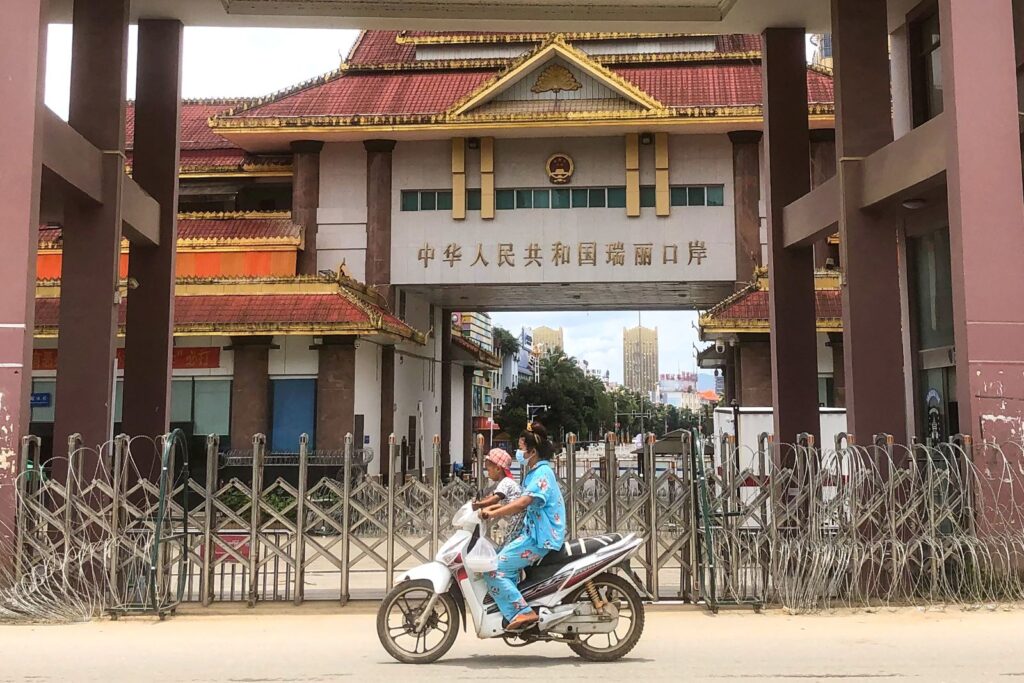
From there, she walked along jungle paths at night to cross the border and reach the Chinese town of Ruili, where she met the woman in the video. She quickly realised she had been deceived and the woman was a human trafficker.
“They confiscated my national registration card as soon as I arrived. Then they took me to a clinic for blood tests and bluntly told me, ‘You have to get married here,’” May Oo said. “I was shocked. I wanted to cry. I immediately refused.”
Another trafficking victim, 23-year-old Ma Thida from a low-income family in Mandalay Region, responded to an online post in April 2023 promising a factory job in Ruili.
“When I arrived in Ruili, it turned out I had to marry a Chinese husband,” she told Frontier by phone, using a pseudonym for her security. She was sold to a farming family in a remote village, forced to marry a man in his 30s and pressured to conceive a child.
“How could I want to have a child? But the marriage had already taken place, and I had to live with my husband in the village. I thought things would settle down if I just gave birth,” Ma Thida said.
She became pregnant about six months after the wedding. The family took good care of her until she had an ultrasound.
“The ultrasound showed it was a girl and the family wanted a boy. They tried to force me to have an abortion. I didn’t want an abortion but they force-fed me medicine. In the end I lost the baby,” she said.
After that, Ma Thida set her sights on escaping. “I didn’t want any more children and I couldn’t go through another abortion,” she said.
She fled her husband’s house early last year and managed to make her way back to Ruili with help from a Chinese driver she met along the way. From there she crossed back into Myanmar.
“Thinking about those events still pains me,” Ma Thida said.
‘I want to go home’
May Oo and Ma Thida both said the brokers they initially dealt with were Myanmar women married to Chinese men living in Ruili.
Ko Win Min, a volunteer working for a civil society organisation in Muse who spoke with Frontier on condition of anonymity, said the brokers tell the women to travel to Muse, from where their transportation costs to Ruili will be paid.
“Once they reach Ruili, they are transferred farther into China,” he said, adding that while Muse is a popular crossing point, others enter China through Mong Paw in the Wa Self-Administered Division or elsewhere. “The routes are all illegal.”
After May Oo made it to Ruili, she was taken by a Chinese driver along with one other woman who was being trafficked. She was driven for a day and a night to the town where she was to be sold to her first husband.
During the course of that journey, she changed vehicles three times. By the time they reached their destination, there were six trafficked women in the vehicle, all from Myanmar.
“Three were tricked and sold like me, while the other three came of their own accord,” she said.
When May Oo finally reached the destination town, she was taken to a house where the Myanmar broker and Chinese buyers communicated using a translation app. She was selected for marriage by a 29-year-old man.
He seemed to have money and took good care of her, but after three days he tried to sleep with her.
“I refused to accept it. Then he called the brokers in Ruili to report my refusal,” May Oo said. “The broker told me to just go along with it. I refused, saying I couldn’t and wouldn’t do it.”
It was then that brokers took May Oo to Xinyu, where she escaped being sold for a second time by running to the police station.
Win Min said CSOs in Myanmar can only provide assistance once victims cross the border back into Muse.
“Some contact us from deep inside China, but we can’t do anything from this side. The percentage of successful rescues from trafficking incidents is very low,” he said.
Meanwhile, escaping into the arms of Chinese authorities often leads to prolonged detention in China because the victims’ identity papers have been seized by the brokers.
This is now May Oo’s situation. She was sent to a social welfare centre late last year and does not know when she will be able to return to Myanmar.
“I don’t want to stay here. I want to go back home right now,” she said. “I regret coming. Every night I pray that I’ll soon be granted permission to return home.”
After her escape, Ma Thida did make her way back to her native village in Mandalay via Muse. But once home, she faced disapproval from villagers.
“The people in our village had trouble believing that I had been trafficked and sold in China to be a wife,” she said.
“Some mocked me and said, ‘She was a Chinese man’s concubine and brought back a lot of money. She’s no longer a virgin.’ I didn’t know how to explain myself when they spoke like that. I just cried.”
Ma Thida said her parents were ashamed of her trafficking experience.
“I didn’t even want to step outside my house. Whenever I went outside, I couldn’t bear the way people looked at me,” she said, adding that after about six months, she left the village to work in Mandalay city. “My family didn’t want me to go, but I couldn’t stay in my village any longer.”