Conflict and a transportation blockade by the junta have led to widespread hunger in Rakhine State, leading residents to take desperate measures, from selling their own blood to killing themselves.
By FRONTIER
A husband and his wife poisoned their three children and then hanged themselves in the Rakhine State capital of Sittwe in late June. They left no explanation, but their neighbours have little doubt it was due to desperate poverty and hunger.
Most of the Rakhine people in Mingan ward, on the westernmost outskirts of Sittwe, are labourers, fisherfolk and trishaw taxi drivers. The husband who hanged himself, Ko Maung Oo, was one of those drivers. He had been struggling for months with little if any work and no money for food for his family, neighbours said.
“They hadn’t eaten a proper meal in a long time. On some days, they had to get by just drinking water from making rice,” Mingan resident Ko Win Maung said.
Win Maung, who used a pseudonym to protect his identity, also told of a Mingan woman who died by suicide in May, the month before the deaths of Maung Oo and his family, also because she was destitute and starving.
Another neighbour, Ko Lin Lin, said Maung Oo and his family just “couldn’t bear it any more”.
“There’s just nothing you can do,” he told Frontier, referring to the sense of desperation in the community and also using a pseudonym. “People around you are in distress, they’re in trouble, and you can’t do anything about it. You can’t help them, you can’t even help yourself.”
Rakhine-based outlet Development Media Group reported in July that the junta, which controls Sittwe town, tried to suppress the news of the family’s deaths.
“[Junta soldiers] immediately took their bodies and cremated them,” a resident told DMG. “The military regime then promptly covered up the news to prevent it from spreading.”
Frontier was unable to contact any regime authorities in Sittwe to ask about the reported suicides.
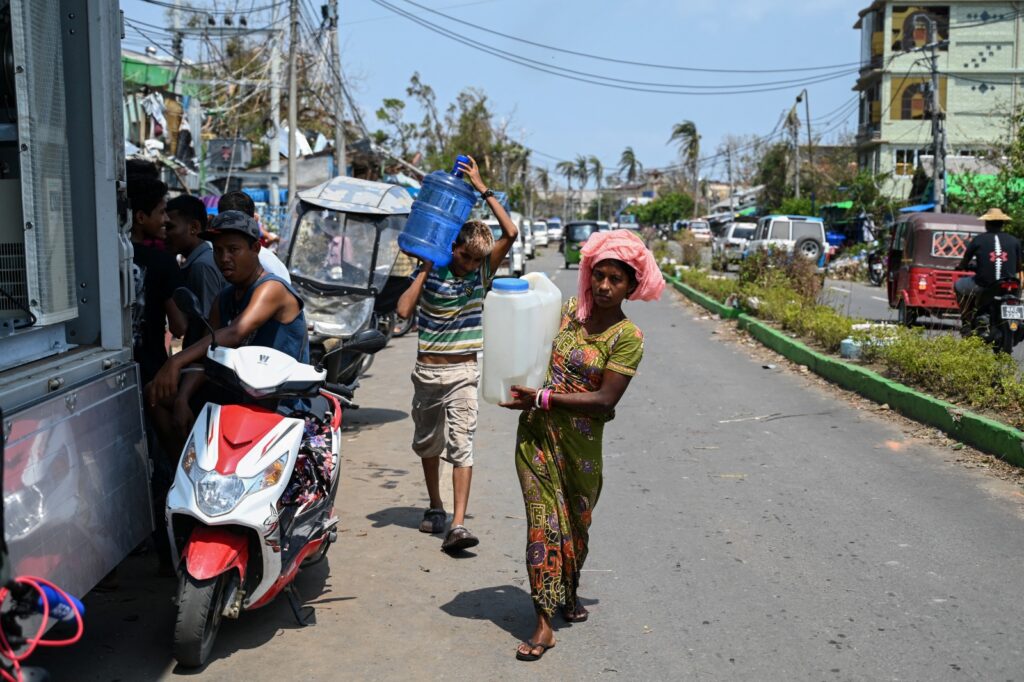
‘Struggling to survive’
Rakhine is facing a food crisis after years of warfare between the Arakan Army and the military, and a regime blockade of transportation in and out of the state – aimed at undermining the AA – is slowly starving the people, residents say.
Myanmar has been in crisis since the military overthrew the elected National League for Democracy government led by Daw Aung San Suu Kyi in February 2021, sparking a groundswell of protest across the country, which the military crushed.
The crackdown triggered armed opposition by a myriad of new groups, many of which linked up with ethnic armed groups that have been battling the central authorities for decades.
The economy has been in freefall since then, while natural disasters, including floods and a 7.7-magnitude earthquake in central Myanmar on March 28, have compounded the crisis. President Donald Trump’s decision in January to cut United States aid has only made the situation worse.
“Four years on from the military takeover, civilians in Myanmar are struggling to survive an unprecedented humanitarian crisis that has upended the lives of millions,” the United Nations Office for the Coordination of Humanitarian Affairs said, adding that nearly 20 million people, more than a third of Myanmar’s population, are in need of assistance.
The situation in Rakhine is particularly grim.
In November 2023, fighting between the military and the AA resumed after a fragile ceasefire that had lasted for more than two years. The Rakhine group has since made spectacular gains, driving the military out of all but three of the state’s 17 townships, leaving the regime bottled up in Sittwe, Kyaukphyu town and Munaung Township.
The junta’s control of Sittwe port has allowed it to stop aid deliveries, and its blockade on other trade routes has exacerbated a severe shortage of food and medicine in Rakhine.
Not surprisingly, prices have surged.
For example, Rakhine residents said that one viss (1.63 kilogrammes) of garlic used to cost K4,000 (about US$0.9 at the market rate) before the coup, but now it costs more than K40,000. Similarly, a viss of chili was about K3,500 before the coup, but the price has soared to K35,000.
“Prices have gone up about tenfold. The local people don’t have jobs, businesses have stopped, so living conditions have become much worse,” U Aye Chan, a trader in Mrauk-U town, told Frontier.
“Some goods come in from India and Bangladesh, and others from central Myanmar, but they can only be transported with great difficulty,” he said, using a pseudonym. “As a result, there are commodity shortages and prices are rising, and there’s even a shortage of cash.”

‘Vicious cycle’
The World Food Programme said in August 57 percent of families in Rakhine cannot meet basic food needs and 1.5 million people are going hungry on a daily basis, selling their last assets to feed their children as they struggle to stave off famine.
Nearly half a million people are displaced in the state, including more than 157,000 members of the persecuted Rohingya minority, according to UN estimates. The AA’s Humanitarian and Development Coordination Office said in December last year there were more than 600,000 internally displaced people in the state.
“People are trapped in a vicious cycle; cut off by conflict, stripped of livelihoods, and left with no humanitarian safety net,” Mr Michael Dunford, the WFP representative and country director in Myanmar, said in a statement on August 12.
“We are hearing heartbreaking stories of children crying from hunger and mothers skipping meals. Families are doing everything they can, but they cannot survive this alone.”
Ko Min Zaw, a member of a social relief organisation working in northern Rakhine who requested the use of a pseudonym to protect his identity, told Frontier that the food crisis is hitting all parts of the state, both the pockets of territory under the regime and the areas controlled by the AA.
“Now that it’s the rainy season, it’s even worse,” he said, referring to the usual decline in economic activity when the rains flood the fields, disrupt fishing and halt construction work. “There are no jobs, no food is available and everything is difficult. Both the displaced people and people in their villages are facing food shortages.”
Min Zaw said that while everyone is facing hardship, it’s the displaced people with no hope of earning any money who are suffering the most.
“They can’t buy meat and fish, they can only eat vegetables,” he said. “The local businesses aren’t operating, so the displaced people just don’t have any opportunities.”
Min Zaw pointed out that civil society organisations like his are starved of international funding and struggling to provide any relief.
“No help is coming from anywhere. The military has blocked it, so everyone’s in trouble,” he said.
Desperate displaced people have been resorting to whatever means they can to survive, and some people are even selling their own blood. DMG reported in September last year that people donating blood in Ponnagyun town are being paid between K100,000 and K200,000 for 450 millilitres.
Rohingya’s suffering
The Rohingya are also suffering under the junta’s blockade – and they are particularly vulnerable.
Communal riots between the mostly stateless minority and the Rakhine majority erupted in 2012. Scores of people were killed and more than 100,000, most of them Rohingya, were displaced. Thirteen years later they are still confined in camps across the state.
A Myanmar military crackdown in northern Rakhine in 2017 displaced hundreds of thousands more Rohingya, with some 750,000 of them fleeing to neighbouring Bangladesh.
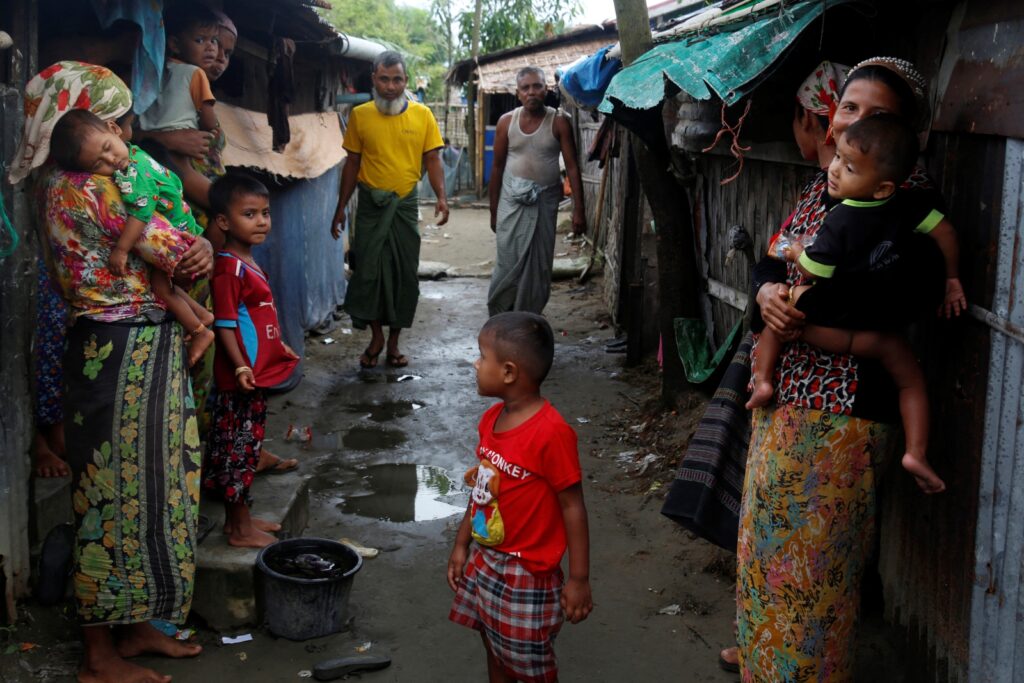
Those who remain in camps for the internally displaced in the state have little hope.
“We’re starving,” said Ko Aung Oo, a Rohingya man living in an IDP camp near Sittwe who requested the use of a pseudonym. “We can’t go out to catch fish. We can’t go anywhere. We only eat plain rice for several days and sometimes we don’t get dinner. No help is coming in from anywhere.”
Aung Oo told Frontier of a Rohingya family that recently died by suicide because they were starving in Sittwe Township’s Thet Kay Pyin village.
“There were about five people. They did it because they could no longer endure the suffering,” he said.
Frontier was not able to verify his account.
“If the roads aren’t opened and aid doesn’t arrive it’ll be very difficult in the long run. We’re already in a lot of trouble now. If we don’t kill ourselves we’ll die of starvation,” Aung Oo said.
‘Worse for women’
The crisis is particularly affecting another vulnerable collective: women.
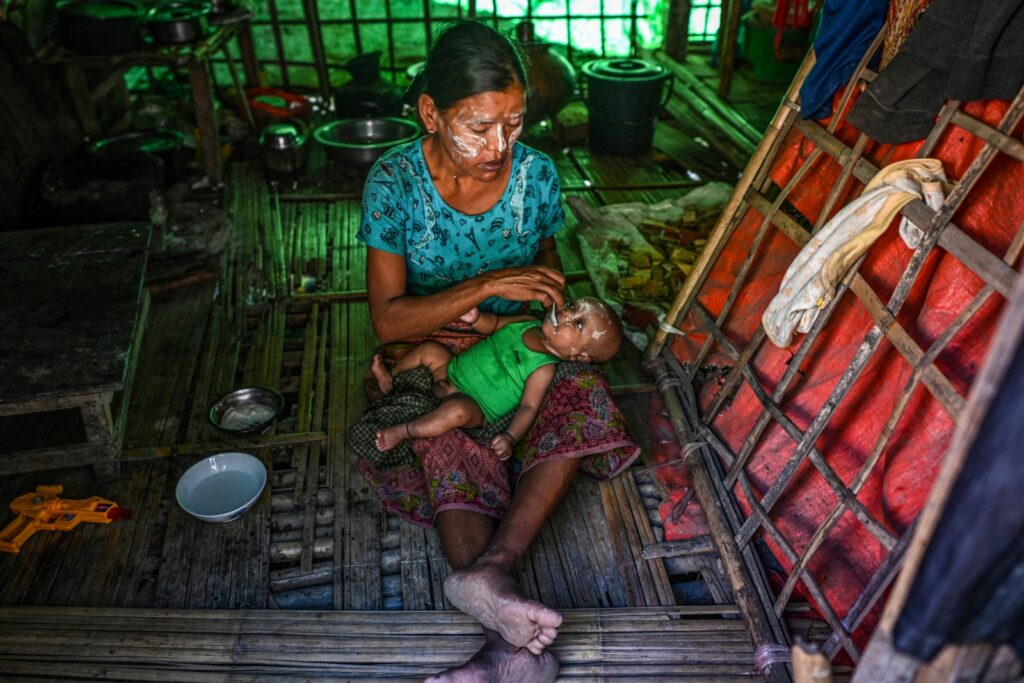
Ma Thein Thein, who requested the use of a pseudonym, lives in an IDP camp in Mrauk-U Township. A mother of two young sons, Thein Thein said her husband went to look for work in Thailand in 2021 but she has not heard from him since then.
Two years ago, she and her boys had to flee from their home because of the conflict between the AA and the regime, and they ended up in the IDP camp.
More than 100 families live in Thein Thein’s camp, and almost everyone is struggling to survive.
“Most of the men would do whatever work they can find but they can’t find jobs,” she told Frontier. “It’s worse for women. We can’t find work and we can only feed our children with rice. We can’t afford meat or fish.”
Desperate women and children venture out of the camp to beg in nearby villages.
“Of course, we feel ashamed but there’s no other choice for us,” Thein Thein said. “If I could just get in touch with my husband, I’m sure things would be okay.”
Back in Sittwe, Win Maung is thankful that his daughter and son are working abroad, escaping the misery at home.
“Sometimes we only have rice to eat. There are days when we only drink the rice water,” he told Frontier.
“Life here is suffocating,” Win Maung said. “There are no jobs and income is irregular. It’s not easy to survive when prices are this high. We’d never heard of people dying of starvation before, but now we see it with our own eyes.”