Pressure from China has forced ethnic armies in Shan State to stop supplying arms to resistance groups in Myanmar’s central Dry Zone, leading to scarcity of guns and ammunition among PDFs struggling to hold ground against the military.
By FRONTIER
In late April, Ko Moe Kyaw participated in an attack on a junta military base in Myaung Township in Sagaing Region.
His 70-member unit – a small resistance force active in Sagaing’s Myaung and Yesagyo townships – was part of a larger force of nine People’s Defence Forces numbering nearly 1,000 fighters involved in the attack. The fighting raged all day, but the military put up a stubborn defence.
“We had a decisive advantage in terms of manpower,” said Moe Kyaw, 33, who used a pseudonym for security reasons.
Then, at the point of victory, the situation changed.
“We started running out of ammunition. That’s when everything fell apart,” he said, adding that they were ultimately forced to withdraw. “It was so demoralising.”
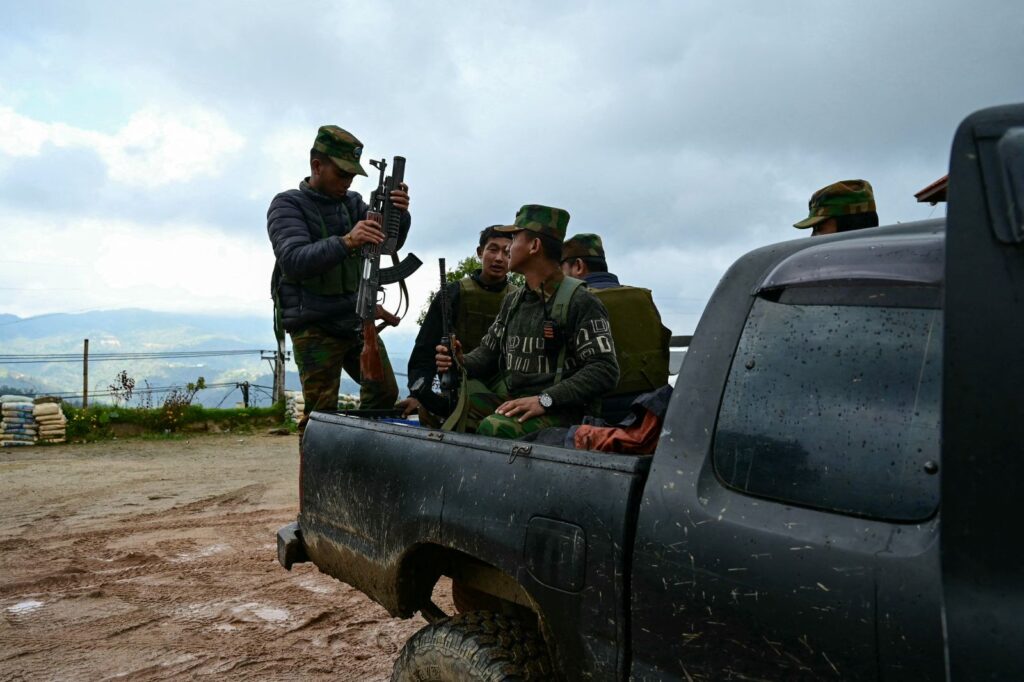
Incidents like this have become increasingly common in recent months for resistance groups in Sagaing, Magway and Mandalay regions. PDFs are having to retreat, or lie low, because they lack ammunition.
According to members of resistance forces interviewed by Frontier, the problems started earlier this year after ethnic armed organisations in northern Shan State began acquiescing to pressure from China to sign peace agreements with the junta, and to stop supplying arms and ammunition to resistance groups.
Arming the resistance
In the months immediately following the February 2021 military coup, many resistance forces from the central Dry Zone attended military training with the Karen National Union in southeastern Myanmar. They began their fight against regime troops using homemade bombs and flintlock rifles called tumi.
Toward the end of 2021, some resistance forces began training with better-armed EAOs like the Kachin Independence Army in Kachin State, and the Ta’ang National Liberation Army and Myanmar National Democratic Alliance Army in northern Shan. New recruits returned to central Myanmar bearing military-grade weapons.
Many of the weapons were “KA” models, produced in KIA factories, and Type 81 automatic rifles, which were originally manufactured in China but are now also produced in factories in the Wa State run by the United Wa State Army – Myanmar’s most powerful EAO.
Type 81 rifles became more common in the Dry Zone after Operation 1027 was launched in October 2023 in northern Shan by the Three Brotherhood Alliance, consisting of the TNLA, MNDAA and Arakan Army. Dry Zone resistance forces that had trained with the TNLA and MNDAA joined the offensive.
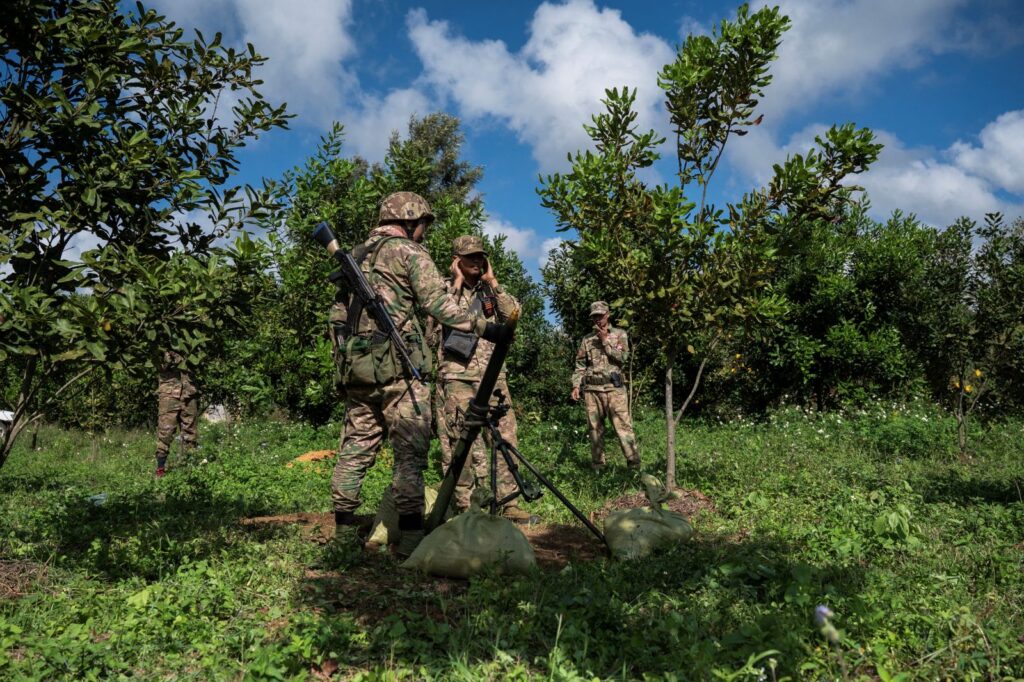
The operation resulted in resistance forces taking huge swathes of territory in northern Shan. After a lull, the resistance launched the second phase of the operation in June last year, during which the MNDAA captured Lashio town, including the regime’s North Eastern Command.
During the affiliated Shan-Man Operation, PDFs captured or helped capture several towns in Mandalay Region, including Madaya, Thabeikkyin, Mogok and Singu.
These gains opened new supply routes through northern Shan for resistance forces, dramatically easing the transport of weapons into the Dry Zone, including Type 81 rifles and ammunition.
Guns seized from defeated regime forces also became available for purchase from the EAOs. Ammunition supplies from factories along the China-Myanmar border were also plentiful.
“Besides Type 81 rifles, guns like [Myanmar-made] MA-1 rifles became widely available for purchase,” said a PDF member from the Dry Zone, who is now based in northern Shan. “Prices also dropped.”
Some resistance groups acted as brokers, reselling weapons purchased from the EAOs to other groups.
“It was a buyer’s market. Even weapons like 60mm mortars became easy to buy,” he said.
Arms sales blocked
The boom didn’t last long. In the wake of the second phase of Operation 1027, China increased pressure on the MNDAA and TNLA to sign ceasefire agreements with the regime. As part of the MNDAA’s agreement, the Kokang group handed Lashio town back to the junta.
Meanwhile the TNLA – after losing the towns of Nawnghkio, Kyaukme and Hsipaw to military offensives – signed an agreement whose stipulations included returning the towns of Momeik, in northern Shan, and Mogok, in Mandalay, to the military.
While it was negotiating with the MNDAA and TNLA, China was also pressuring the UWSA to stop supplying arms to EAOs and other resistance groups. As a result of this coercion, the UWSA called a meeting with its allies on August 20.
Attendees included the MNDAA, TNLA and Shan State Progress Party. The UWSA announced it would no longer provide support, financial aid or travel routes to resistance groups for military activities.
The move by the UWSA had a dramatic effect. On December 2, TNLA Major-General Tar Bone Kyaw said the Ta’ang group was forced into its ceasefire with the junta because of a critical lack of ammunition, funding and manpower, compounded by billions of dollars of debt incurred from buying weapons.
Ko Lin Htain, a member of a PDF based in Sagaing’s Kani Township, told Frontier that the UWSA’s decision to stop supplying support “hit everyone hard”.
“After that, weapon prices started rising all over the Dry Zone. The price of ammunition also rose dramatically,” he said.
Ko Aung Lwin, a PDF member from Sagaing’s Yinmabin Township, who used a pseudonym for his security, said that after the UWSA’s announcement, “brokers began jacking up the prices”.
“Before that, an automatic rifle cost around K10 million [US$2,490 at the market rate]. Now it’s gone up to around K25 million. Rocket-propelled grenades have also gone up in price, so now we have to mainly rely on handmade RPGs,” he said. One round for an RPG used to cost around K80,000. It then rose to K150,000 and now costs over K200,000.
Causing even greater difficulty for the resistance is the rising cost of bullets. The price of a single 5.56mm bullet has risen from K5,000 to K8,500 since early this year.
“Prices are going up because supplies are scarce and the kyat is depreciating. All factors point to prices continuing to rise, and the more they rise, the harder it is to fight,” Aung Lwin said.
Amid these shortages, the military has been advancing in resistance-controlled townships in the Dry Zone since early this year. Sources said that by the end of November, for example, the regime had regained control over more than 90 percent of Madaya Township in Mandalay.
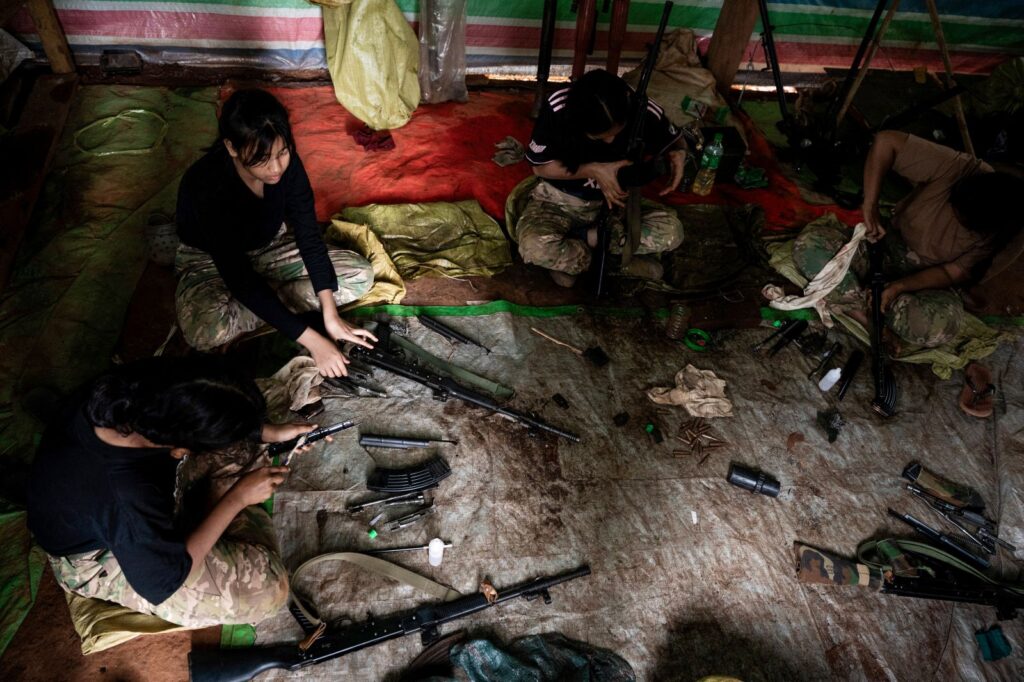
Desperate measures
The NUG-affiliated Shwebo District PDF Battalion 9706 – also known as the Daung Ni (Red Peacock) Force – is among the groups that participated in the 1027 and Shan-Man operations. Nine members were killed while fighting alongside the TNLA in northern Shan’s Nawnghkio town, which was retaken by junta forces in July after a long battle.
In late July, a post appeared on the Daung Ni social media page announcing, “Battalion Commander for Sale”, suggesting they would “sell” their battalion commander for K10 million to raise funds for critically needed ammunition. The post was intended as a joke, but it pointed to serious problems faced by PDFs.
“We even had to pawn our personal handguns,” a Daung Ni member told Myae Latt Athan news agency. “When we couldn’t find another way to get more ammo, this ‘content’ idea popped into my head, and I posted it without consulting the battalion commander.”
He added that a minimum of 30,000 bullets is needed to fight a major battle. Because each soldier requires at least 200 bullets for even minor clashes, many PDFs now avoid large-scale battles.
“The bigger the battle, the higher the need – 30,000 bullets mean one battle costs about K25 million, without including helmets or body armour,” he said.
As a result, resistance forces now spend much of their time fundraising and searching for other sources of money to cover costs.
“We have to seriously reconsider whether to launch attacks. Without bullets, guns are just toys. They’re useless,” resistance fighter Moe Kyaw said. “If the public gives us bullets, we will fight for the public.”
He added, “New guys just want to shoot. When they get into a fight, they just go ‘bang, bang’ without thinking about the consequences. We were like that too – I understand them. But now, if we shoot and run out of bullets, what do we do when the military storms our positions?”
While some groups in the Dry Zone receive around K10 million quarterly from the NUG, others get no support at all. The Daung Ni Force, for example, did not receive any financial or food support in the six months leading up to November.
“Sometimes we get it. But the amount we get is not enough to buy arms and ammunition. We are struggling just for food,” Lin Htain said.
“We have to save money to buy guns. We must work for it. If we have our own private money, we must use that. Sometimes we buy weapons using high-interest loans. It doesn’t end there. The ammunition demand for guns is enormous,” the leader of Daung Ni told Myay Latt Athan.
“It’s hard to fight in this situation. Many groups are struggling,” Lin Htain said. “It doesn’t matter who supports us. The revolution will only be successful if we have backing.”
Frontier reached out to the NUG for comment but received no response.
Meanwhile, many resistance groups fear that, with Chinese support after its recent gains in Shan, the military will continue intensifying its operations in the Dry Zone.
“We hear military columns are planning to advance further into our areas of control,” Moe Kyaw said. “We won’t be able to launch any offensives now. We can barely prepare our defences.”
He said it’s hard to calculate how much ammunition will be needed, even for the near future.
“We can only estimate how much we need when we are on the offensive,” he said. “We’ll have to play it by ear. We’ll advance when we can and retreat when we must. We can’t allow our comrades who have died to be sacrificed in vain.”