The arrests in India of seven foreigners accused of crossing into Myanmar to help resistance groups has raised fresh concerns about security along the rugged, porous border between the two countries.
By KARISHMA HASNAT | FRONTIER
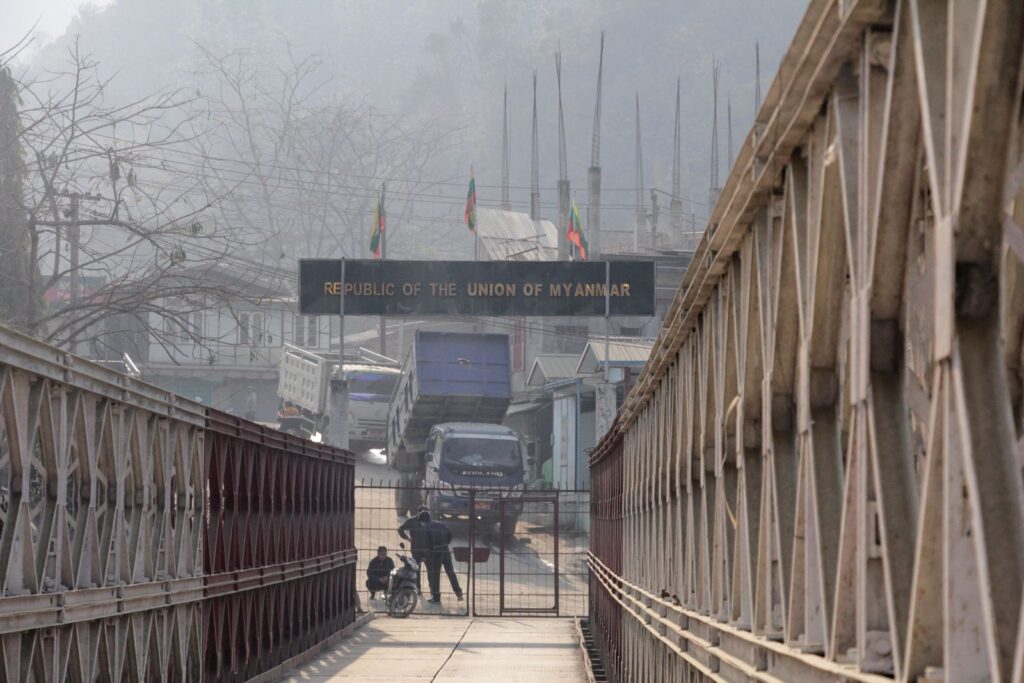
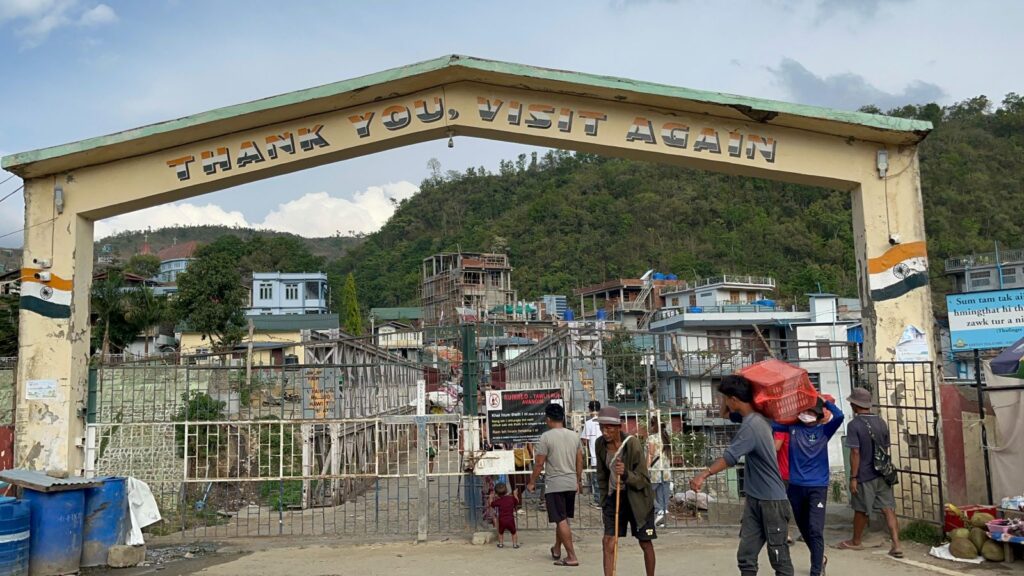
On a breezy morning last month, workers were busy fixing the roof of Sunrise Christian College in Chin State’s Khawmawi village, as headmaster Paul Lalhmingthanga prepared to cross into India. The town of Zokhawthar, just a few kilometres away in India’s Mizoram state, is where he goes to buy construction materials for the school and food for its students.
Such trips used to be more frequent, but permit regulations instituted in January last year have made crossborder travel much more difficult.
“We don’t visit Zokhawthar as often nowadays – maybe three or four times a month. Every time we cross over, we need a border permit from the Assam Rifles,” Lalhmingthanga said, referring to the Indian paramilitary force responsible for border security in northeast India.
Border regulations have been tightened along India’s northeastern frontier due to increased security concerns since the February 2021 coup in Myanmar. These concerns were highlighted by the arrests of seven foreigners on March 13 by Indian authorities. The six Ukrainians and one United States citizen were suspected of illegally crossing into Myanmar to train ethnic armed organisations.
Since the arrests, border security has become even tighter.
India’s National Investigation Agency claimed the detainees provided military training on drone warfare, including assembly and jamming technology, to resistance groups that “support terrorist organisations operating in India.”
Rakhine State-based news outlet Narinjara quoted Indian outlet The Pioneer as saying the foreigners were transporting drones to the Arakan Army, Kachin Independence Army and Chin resistance forces. However, AA spokesperson Khaing Thu Kha denied that his group had ties with them. “This matter has nothing to do with us and there is no connection whatsoever,” he said.
Some Indian media reports said the EAOs have been “supporting Indian insurgent groups by supplying arms and ammunition.” Some pointed to a “high stakes conspiracy,” with EAOs allegedly supplying and training Indian insurgent groups in drone warfare.
However, India’s home minister Amit Shah said the arrested foreigners posed no threat to India but were trying to use the country as a transit point to Myanmar for “terror training at insurgent bases.”
Of the seven foreigners, US citizen Matthew Aaron VanDyke, who claims to have fought alongside rebels who ousted Libyan leader Muammar Gaddafi in 2011 and Ukrainian troops resisting Russia’s invasion of Ukraine in 2022, was detained at Kolkata airport. Of the six Ukrainians, Hurba Petro, Slyviak Taras and Ivan Sukmanovskyi were held at Lucknow airport, while Stefankiv Marian, Honcharuk Maksim and Kaminskyi Viktor were picked up at Delhi airport.
All of them were taken to court in New Delhi on March 16, and held in NIA custody. The initial custody of 11 days was later extended by another 10 days for further investigation. On April 6, a special NIA court in Delhi remanded all of the accused to 30 days’ judicial custody in a terror case registered under the Unlawful Activities (Prevention) Act.
A porous border
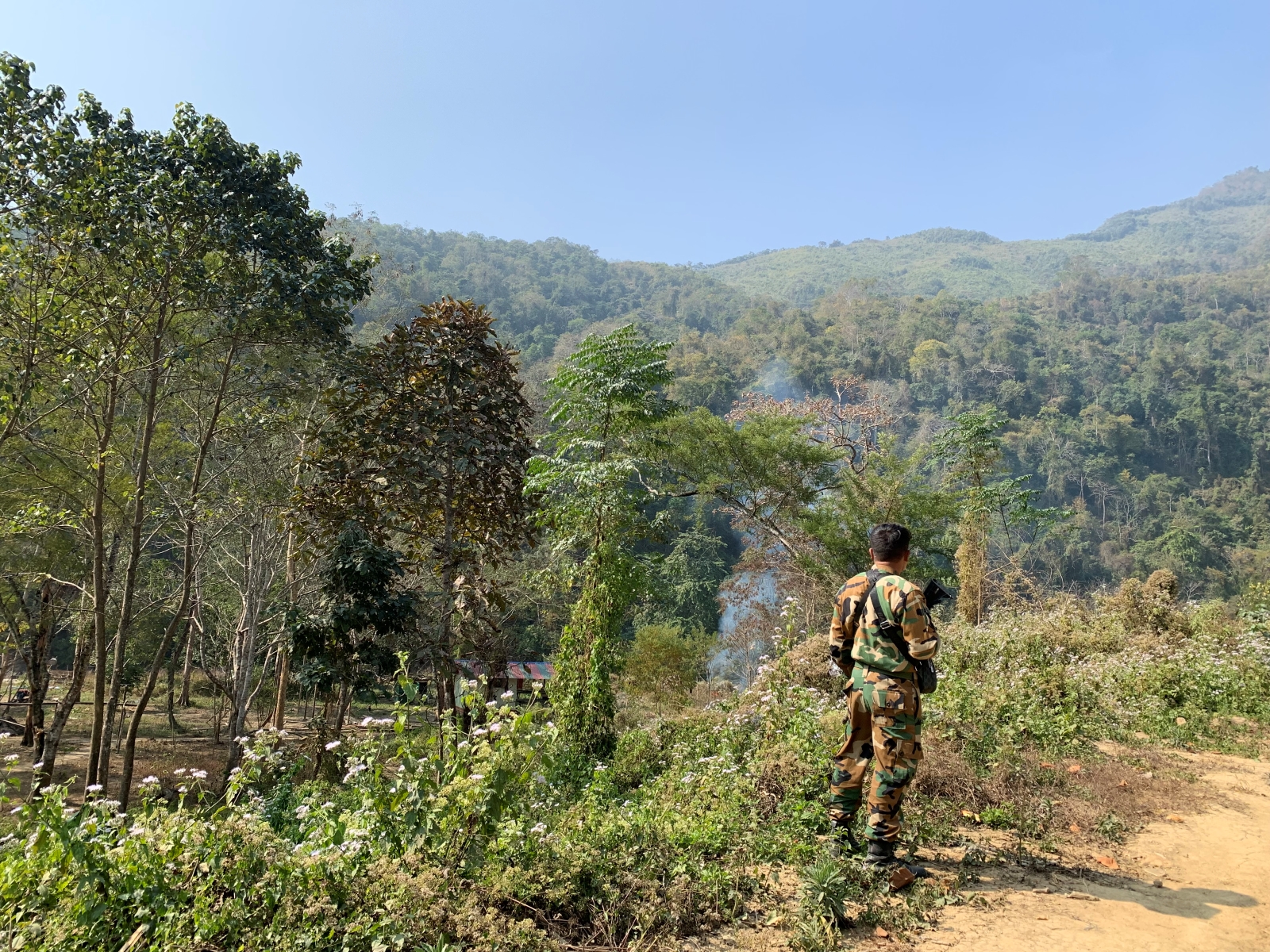
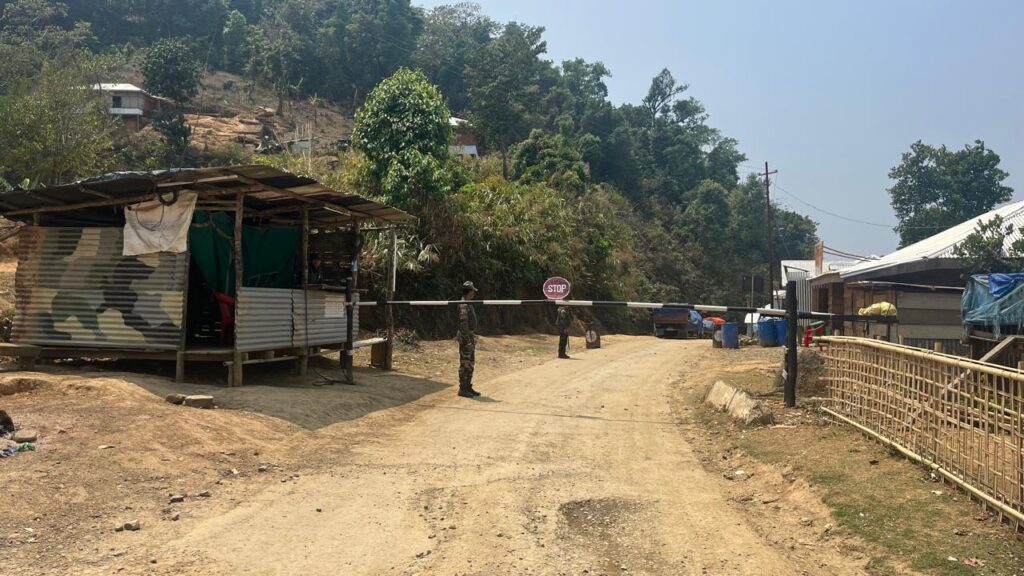
India and Myanmar share a 1,643km border. On the Indian side are the northeastern states of Arunachal Pradesh, Nagaland, Manipur and Mizoram, while on the Myanmar side are Chin, Kachin and Rakhine states, and Sagaing Region.
The 510km border with Mizoram, across from Chin, in particular has seen rising displacement, disrupted commerce, and smuggling of weapons and drugs since the 2021 military coup in Myanmar.
In the past two years, however, Mizoram has also recorded more than 1.2 million tourists, including nearly 17,000 foreigners, tourism minister Lalnghinglova Hmar said in a state assembly session last month. Foreigners require a Protected Area Permit to visit Mizoram, which is deemed sensitive because it lies close to an international border. However, it’s still easy for foreigners to travel to the state, with some even crossing into Chin using informal routes.
Many such border crossings have gone unnoticed, but in November last year, US freelance journalist Colin Mayfield was injured by a landmine while covering the civil war in Chin’s Tedim Township. He was evacuated to a hospital in the Mizoram capital of Aizawl for treatment and was later deported.
Last month, Mizoram police detained a Slovak and a Russian national at separate locations for entering Mizoram without the required PAPs.
As for the seven foreigners arrested last month, senior officials in the police and home department – speaking to Frontier on condition of anonymity – said there is no record of them on entry registers at Lengpui Airport or Sairang Railway Station in Mizoram. If they did cross into Myanmar via Mizoram, they likely entered the state by road using clandestine routes, possibly via Assam state.
Bertil Lintner, author and long-time Myanmar observer, told Frontier he does not see a “big conspiracy” in these incidents. While such clandestine crossings have long been common along the Thai-Myanmar border, they are a relatively recent phenomenon at the India-Myanmar border.
“The Chins, who live in Chin State opposite Mizoram, have a very wide and effective PR network in the West, especially in the US, and they must have arranged for these foreigners to travel to Mizoram and attempt to cross the border,” Lintner said.
“But it’s uncertain which rebel groups inside Chin State they were attempting to contact because there are several rival Chin rebel armies. Some Chin rebel groups have close contacts with the Kuki insurgent groups operating in Myanmar.”
Silence or support
For many residents on the Myanmar side, India is no foreign country. The resistance against the junta has strong connections with Mizoram. Ties of ethnicity and kinship bind Chin and Mizo communities across the Tiau River, the natural boundary between the two countries. People living on either side of the India-Myanmar border largely belong to the Kuki-Chin-Zomi-Mizo tribe.
However, in interviews with Frontier, representatives of Chin armed groups denied claims of supporting Indian insurgent groups or involvement in training by the seven arrested individuals.
“All accusations that we are helping anti-India insurgent groups are baseless,” said Dr Sui Khar, vice chairman 2 of the Chin National Front. “We are defending our own territory in Chin State. Any technology we use in warfare is learned from tutorials available on the internet. We do have NGOs run by Chin brethren that contribute funds, not weapons. India should either remain silent or support our movement.”
There are more than two dozen anti-junta armies in Chin, representing different Chin sub-groups speaking often mutually unintelligible languages. The majority were formed in opposition to the 2021 coup.
Over the past two years, however, they have split into two main factions: one represented by the Chinland Council, which claims the right to govern the state and is dominated by the CNF, and the other consisting of the Chin Brotherhood, whose six members were all established after the coup.
Brotherhood member the Chin National Defence Force also denied any connection with the arrested foreigners.
“This group of foreigners has nothing to do with us or the Chin Brotherhood,” said Salai Timmy Htut, spokesperson of the CNDF.
However, Htut said his group has worked with the relatively new Anti-Fascist International Front in the Falam region and areas controlled by the Chin Brotherhood. The AIF comprises foreign volunteers fighting alongside resistance forces.
“We are not anti-India. Rather, we desire to work together with the government in India, because we have no other hope from any other neighbouring country,” said Peter Thang, vice president 1 of the CNDF.
“We share ethnic ties with the Mizos. We are of the same clan, the same tribal roots, tracing origins to the same forefathers. As a people, we are fighting a dictatorship in Myanmar and look to India, the world’s largest democracy, for support. Acting against India or its policies would not serve our cause in any way.”
Coup aftermath
India and Myanmar share a Free Movement Regime that allows people living along the border to travel into each other’s territory without a visa.
But in January last year, India’s Ministry of Home Affairs made border passes mandatory for people living within 10km of the border. These passes – which are issued only to those eligible under the FMR and are valid for 10 days on either side of the border – are what have made crossborder travel from Chin’s Khawmawi village to Mizoram’s Zokhawthar more difficult for people like school headmaster Lalhmingthanga.
Amid the increased contraband and smuggling of weapons and drugs since the coup in Myanmar, anti-smuggling operations by security forces in Mizoram – including state police, the Assam Rifles, and the Department of Excise and Narcotics – have resulted in record seizures. The majority have occurred in Champhai district.
So far this year, narcotics and contraband items worth 2.63 billion rupees (US$31.7 million) have been seized in the state. In the past three months, 21 weapons have been seized, and at least 40 Indians and 11 Myanmar nationals have been apprehended on charges of smuggling.
“There has been a rise in smuggling activity with women and minors also being used in drug trafficking. The easy availability of drugs has led to increased local consumption,” said a security official who served in Mizoram.
Retired Lieutenant-General Shokin Chauhan, a former director-general of the Assam Rifles and ex-chair of the Cease Fire Monitoring Group, said policing the India-Myanmar border is not merely a security challenge.
“How does a state assert control over a region where communities transcend borders, the terrain defies infrastructure, insurgency dissolves into the fabric of society and instability seeps in from beyond its frontiers?” he said.
The Assam Rifles have long borne this burden but face limits from manpower, patchy surveillance, unreliable local intelligence and crossborder political sensitivities, he explained, adding, “Complete control is neither feasible nor desirable. What is required is calibrated management.”
A home department official said that around 28,355 displaced Myanmar nationals are currently sheltering in Mizoram, with nearly 93 percent having completed enrolment in the Mizoram government’s biometric program for Myanmar nationals taking refuge in the state.
Lintner said there are “tens of thousands of Chins working in Mizoram – from construction workers to maids and domestic helpers.”
“But we can’t escape the fact that there is a border separating northeast India from Myanmar, which restricts the movements – and jurisdiction – of the Indian forces guarding it,” he said.
Northeast insurgent groups
As the investigation into the seven arrested foreigners got underway, one report quoted Indian officials as suggesting the arrests exposed “deep security vulnerabilities” along the Myanmar border.
Almost every ethnic group in northeastern India asserts a claim over a defined territory in the name of self-determination, triggering conflict among a number of these groups.
The porous border and kinship ties make these land and identity issues even more complex. Lintner said ethnic insurgents from Manipur and Nagaland, and previously Mizoram, have taken advantage of the situation at the border by establishing bases on the Myanmar side, “from where they could launch raids into India before retreating safely into Myanmar.”
Chauhan described the India-Myanmar frontier as one of the least regulated borders in the world.
“The terrain resists control. There are no straight lines here. Only gradients, shadows and pathways are known to those who belong. For a soldier, it is a nightmare. For an insurgent or an external actor, it is an opportunity,” he said.
“These same routes that allow a family to attend a funeral across the border can also allow movement of insurgents, trafficking of weapons, transfer of narcotics and now, apparently, the alleged entry of foreign mercenaries and trainers.”
Myanmar’s post-coup conflict has intensified border insecurity not only in Mizoram but also in the state of Manipur, which has been in the throes of its own ethnic conflict since 2023. In the past two years, the crisis in Manipur has taken a darker turn with the alleged use of drones and rocket systems to launch offensives.
The coup has also affected the operational dynamics of northeast Indian insurgent groups using bases in Myanmar.
The United Liberation Front of Asom-Independent is now a shadow of its former self, with an estimated 150 cadres, while the Naga insurgent movement has splintered into several rival factions. Many of these groups maintain camps in the mountainous terrain of Sagaing. The National Socialist Council of Nagalim-Isak Muivah faction has a significant armed presence in Myanmar opposite Manipur.
The Manipuri valley groups, meanwhile, are loyal to the junta’s army but are mostly striving to survive in a hostile environment, security sources said. Among these groups are the People’s Liberation Army, both factions of the People’s Revolutionary Party of Kangleipak, the United National Liberation Front, Kangleipak Communist Party and Kanglei Yawol Kanna Lup, which have been taking shelter at the Min Thar camp in Sagaing Region, alongside Myanmar regime forces, sources said.
N Biren Singh, the former chief minister of Manipur, had on several occasions claimed the involvement of Myanmar-based insurgent groups, including the Kuki National Army-Burma, in the present conflict in the state. He had earlier referred to the arrest of a KNA-B cadre in Manipur, indicating “foreign involvement” in the crisis.
In the past, the KNA-B had a tacit understanding with Manipuri-valley based insurgent groups operating from Myanmar, largely transactional in nature. But now the KNA-B is aligned with the People’s Defence Forces, launching joint anti-junta operations in Chin’s Tonzang and Tamu townships under the supervision of the KIA.
When the Manipur conflict broke out in 2023, reports had highlighted that insurgents were active in both hill and valley regions of the state, particularly in various locations near the foothills, further complicating the situation.
In the light of all this, Chauhan said the recent arrest of the seven foreigners – if accusations of crossing the border are substantiated – point to a dangerous shift in the conflict and must be treated as an “early warning.”
“The involvement of foreign nationals, particularly individuals linked to modern conflict zones like Ukraine, if proven, introduces a new dimension. Importantly, it means the transfer of battlefield experience,” he said.
Such incidents only deepen the uncertainty for many people living along the India-Myanmar border. While New Delhi refuses to recognise displaced Myanmar nationals as refugees, and while Manipur has taken a harsh stance regarding the displaced, Mizoram authorities have aided their arrival.
It has been four years since 45-year-old Jessica LK fled her home in Sagaing’s Kalay Township to escape the civil war and settled in Zokhawthar. Her children have been admitted to the government school in the town, but Jessica explained how everyday life depends on frequently crossing the border for various needs, and how the tightening of regulations since early last year has made movement far more difficult.
The impact is felt more strongly in Myanmar, she said, because many people don’t have proper identification – “neither Indian citizenship nor valid Myanmar documents.”
“Many people in Myanmar’s border areas don’t have a national ID because they live far from cities where central government offices are located. Documentation was a challenge even before the coup,” she said.
She said Indian authorities have become even stricter about border security since the arrest of the seven foreigners last month, but many locals are not even aware of the incident.
“We used to see foreigners in Zokhawthar, but now I don’t see any,” Jessica said. “Some say the restrictions are due to drug trafficking, but many don’t believe that. Instead, people across the border in Myanmar see it as a sign that the Indian government is not supporting the revolution.”
Additional reporting by Isaac Zoramsanga.