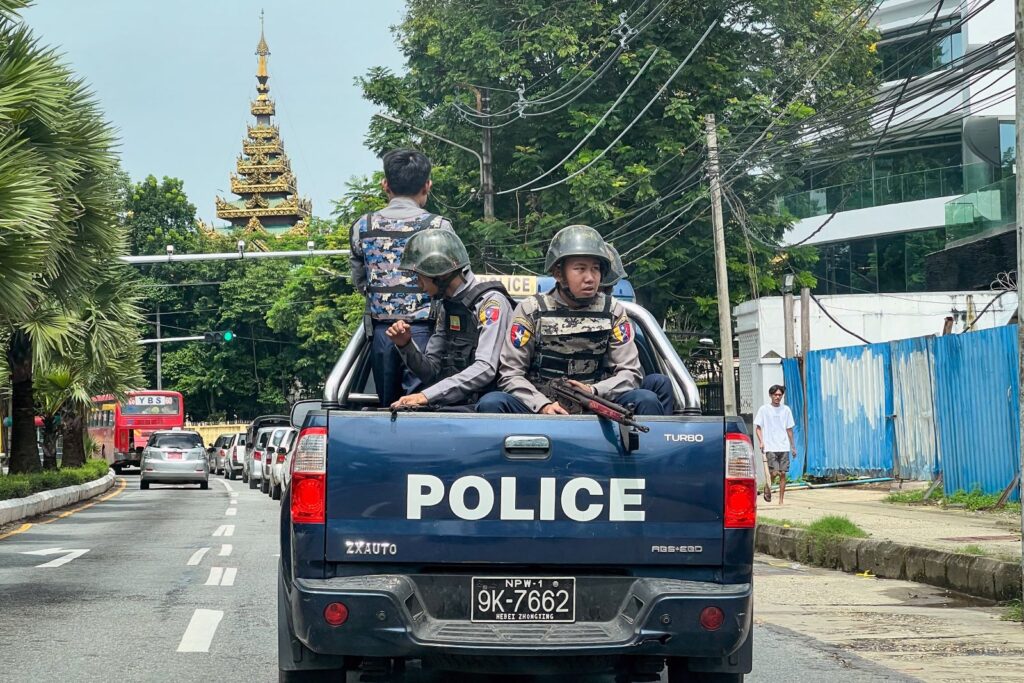
Myanmar’s regime is hunting down those who oppose its upcoming election by using a law criminalising any criticism of the poll, detaining and handing long jail sentences to a wide array of people, from film stars to ordinary citizens.
By FRONTIER
On October 27, Myanmar rapper Ko Yan Yan Chan wrote a Facebook post from his exile in the United States, denouncing the pressure exerted by his home country’s military regime on actors and artists to promote the junta’s upcoming election.
Two days later, the regime arrested film director Ko Aung Chan Lu at his house in Yangon for “liking” Yan Yan Chan’s post. Screenshots of the director’s “like” had circulated on pro-junta Telegram groups, along with calls for his arrest.
“When he realised the danger, he deleted his Facebook reactions, but it was too late,” a relative of Aung Chan Lu told Frontier on condition of anonymity. “The next day, the military arrested him at his home in [Yangon’s] Bahan Township.”
The chain of events leading to Aung Chan Lu’s arrest started on October 25, when a short film promoting the election was screened on junta-controlled television channels. Produced by the regime, the film showed famous actors – who in years gone by had won Myanmar Motion Picture Academy Awards, popularly known as Myanmar Oscars – supporting the poll.
The film triggered calls to boycott the participating actors. Predictably, the junta responded by cracking down on those who criticised the film. On October 31, junta-controlled media announced that Aung Chan Lu had been arrested two days earlier, and that another film director, U Zabu Tun Thet Lwin, had also been detained on the same day.
They were accused of showing support for “terrorist groups” and refusing to promote the election. The junta said they would be prosecuted under the Law on the Protection of Multiparty Democratic General Elections from Obstruction, Disruption, and Destruction, which was enacted on July 29. According to the law, also known as the Election Protection Law, any person found guilty of criticising or disrupting the poll will face a sentence ranging from three years in prison to the death penalty for cases involving violent actions.
Aung Chan Lu had participated in protests against the regime in the immediate aftermath of the February 2021 coup, and the article in state media about his detention included a photo taken at that time.
“It seems they included old photos and built up the case to be more serious out of spite, because he had opposed the military before,” Aung Chan Lu’s relative said. “Moreover, he didn’t write or post the content himself this time. Arresting someone just for giving a ‘react’ on Facebook is truly unjust.”
Pressure on artists
The regime plans to hold its controversial election in three phases starting on December 28 and continuing into January. The poll has been widely derided by anti-junta groups and other observers as a sham designed by the military to perpetuate its hold on power.
The military has banned some of the most important and popular political parties – including the National League for Democracy, which ruled from 2016 until the coup – and has given its proxy, the Union Solidarity and Development Party, advantages that virtually ensure it will come out on top.
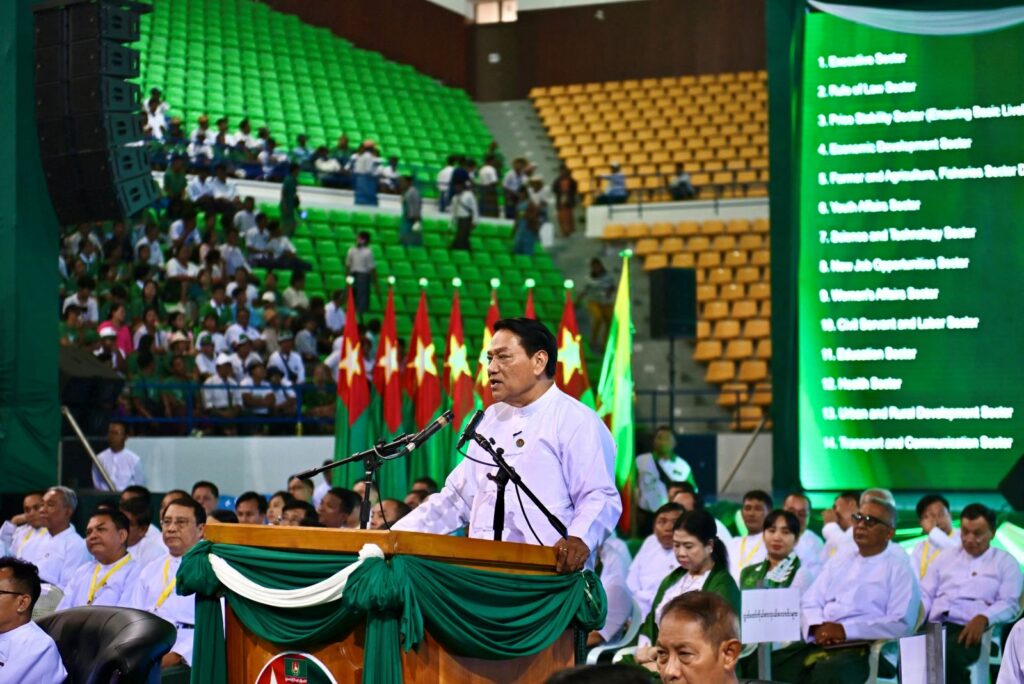
In an attempt to counter the unpopularity of the poll among the public, the regime has recruited film stars to promote it, but some have refused to do so.
The junta has targeted such artists with the Election Protection Law. On October 27, two days before arresting Aung Chan Lu, the regime detained film director Mike Tee and two actors for reacting to Facebook posts criticising the short film promoting the election. Last month, they were each sentenced to seven years in prison.
A filmmaker based in Yangon told Frontier that many in the entertainment sector fear arrest and no one dares to refuse demands made by the junta’s Ministry of Information in October to produce content supporting the election.
“That short film was commissioned by the Union Election Commission, through the Ministry of Information, and then the [Myanmar Motion Picture Organisation and Myanmar Music Association] did the work. Some actors who refused to cooperate have been interrogated. Even though many don’t want to participate, they are forced to do so out of fear,” he told Frontier on November 12 on condition of anonymity.
In early November, the junta reportedly detained famous actor Ma Phway Phway, a three-time Myanmar Oscar winner, in Mandalay Region’s Pyin Oo Lwin town, where she was shooting a movie. She had not responded to a request by the information ministry to participate in activities promoting the regime’s election. The threat of detention apparently worked: one week later, she appeared with other celebrities in a video promoting the election.
Lawyer U Kyee Myint, a former political prisoner and chair of the now-banned Union Lawyers and Legal Aid Board, told Frontier that the junta is threatening celebrities under the Election Protection Law because it wants to set an example to the wider public.
“The junta is doing this to remove obstacles to its election,” he said. “They’re trying to use the election to resolve the country’s political crisis. China is putting pressure on them, so they are absolutely compelled to carry this out and can’t afford to fail. They’re showing they will do whatever it takes, no matter who they have to kill or what they have to do. It’s an election held under fear.”
Casting a wide net
While the prosecution of filmmakers and artists under the Election Protection Law has gained widespread attention, the law has been used more widely to arrest anyone daring to criticise the poll. Regime-controlled media reported on November 18 that more than 100 people had been charged under the law. Over 30 of them had been arrested, but the majority were still at large.
Three of them were arrested in Yangon’s East Hlaing Tharyar Township in September – two young men and a young woman who had pasted stickers around the neighbourhood criticising the election. Last month, they were sentenced to jail terms ranging from 42 to 49 years each, with hard labour, under Section 23(a) of the Election Protection Law.
That section criminalises anyone who “by any means, preaches, speaks, organises, incites, demonstrates, or publishes written materials in order to disrupt or damage the election process or any part of the process”. The lengthy sentences were imposed because they faced separate charges for each sticker they pasted.
A source close to the defendants told Frontier that their families will appeal the sentences because they think they are disproportionately harsh.
“The woman is only 19 years old and the two men are 23 and 25 years old,” the source said, speaking on condition of anonymity. “The girl was not even present in the CCTV footage they showed in court, but she was sentenced to 42 years in prison.”
The harshness of the sentences is also likely explained by their membership in the Shwe Pyi Thar Strike Committee, a pro-democracy and labour rights group based in Yangon. One of them, Ko Yan Naing Kyi Win, had already been arrested during the protests in the aftermath of the 2021 coup, and was released in 2023.
The spokesperson of the SPTSC, Ko Nay Aung, told Frontier that the three members of the group were merely trying to express their ideas, and that the junta will not be able to stop young people’s desire to resist the election.
“The junta is acting hypocritically. They are killing, raping and bombing people, but they believe they can hold a genuine election,” he said. “Sentencing young people to these long prison terms is an intimidation tactic. However, I believe that our youth will not be scared away and will continue to oppose the election.”
Minors have also been arrested under the Election Protection Law. On September 14, the regime arrested five individuals – including two 18-year-olds and three minors aged 14, 16 and 17 – in Loikaw town, the capital of Karenni State (also known as Kayah).
The junta-run Mirror Daily newspaper reported the arrests on September 23, but offered few details, except that the five youths had been charged under Section 23(a) of the Election Protection Law.
Loikaw residents told Frontier that they were arrested for singing “Yaung Ni” (“the colour of sunrise”), a protest song encouraging people to keep fighting for freedom. It was composed by Linn Linn, a singer who was once a bodyguard of the jailed NLD leader Daw Aung San Suu Kyi.
“There is a large lake in Loikaw where people often go to relax,” a Loikaw resident told Frontier on condition of anonymity. “Young people frequently go there to play the guitar and sing. It was there that those young people were arrested for singing a revolutionary song.”
Ko Nay Phone Latt, the spokesperson for the parallel National Unity Government, said the series of arrests by the regime before the election has further destroyed freedom of expression in Myanmar.
“The junta is using these arrests as an intimidation tactic designed to instil fear in the public, so that they do not dare to criticise the illegal election, even slightly,” he said.
He admitted that the NUG is unable to provide protection from such arrests for people living in areas controlled by the regime. However, he urged the public to report these incidents to the complaints channel opened by the parallel government’s Ministry of Home Affairs, providing the names and personal information of those involved in the arrests, along with supporting evidence.
“We will take legal action against the perpetrators, as required by the law,” Nay Phone Latt said. “Even if we cannot arrest them immediately because they are in military-controlled territory, we will issue arrest warrants and file charges in absentia. We will arrest and prosecute those individuals if and when they cross into areas under our control.”
“There are already cases where action has been taken,” he added, without providing examples of such cases.
The NUG is hardly in a position to protect people in Myanmar from the junta’s wrath, but that did not prevent Nay Phone Latt from encouraging citizens to oppose the poll.
“We are not opposing the election system as such,” he said. “But the military is a terrorist organisation and they don’t have the right to hold an election. That’s why we are calling for opposition to it, because it is a sham election.”