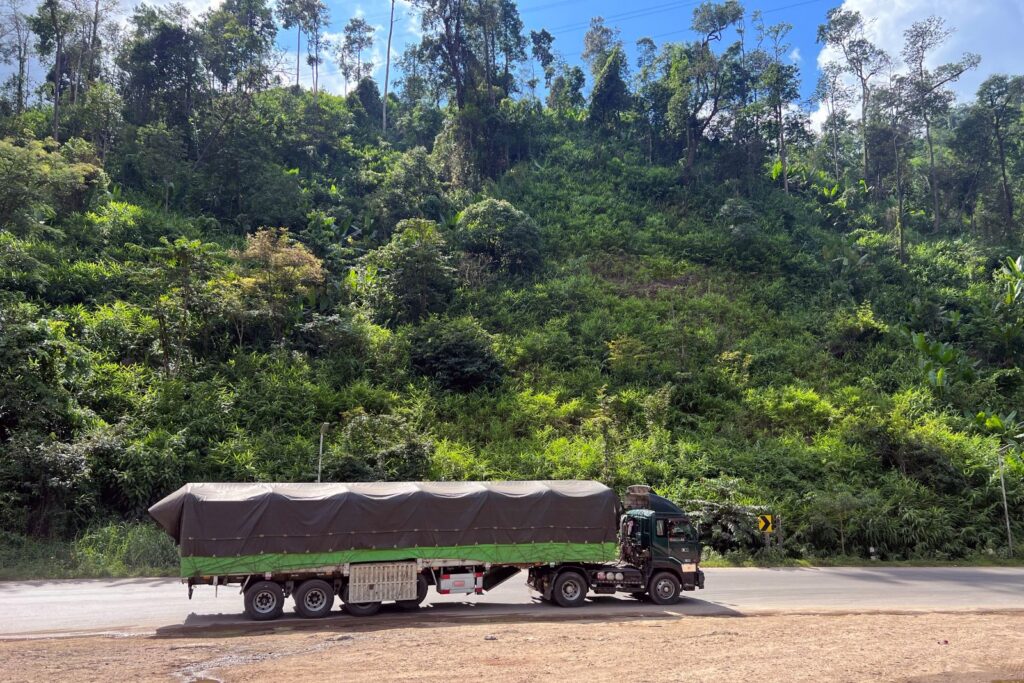
Draconian import restrictions imposed by the Myanmar regime are taking a toll on traders and driving up consumer prices – with some local administrators reaping the benefits.
By HTET AUNG | FRONTIER
Flanked by concrete barricades and equipped with an X-ray scanner, the checkpoint near Nyaung Khar Shey village, in Bago Region’s Waw Township, had been known in recent years for its long queues of trucks carrying goods to Yangon from southern Myanmar.
The checkpoint lies on Asian Highway 1, a crucial artery for trade with neighbouring Thailand. However, the bustling activity that once defined the facility appears to be a thing of the past, at least for now.
On an evening in the second week of September, the checkpoint was strikingly quiet – only a few cargo trucks waited to pass through, reflecting how traffic along Asian Highway 1 has dwindled to a trickle.
During a two-hour drive from Kyaikto town, in Mon State, to the state capital Mawlamyine, Frontier encountered few cargo trucks, with traffic consisting mostly of passenger cars and buses.
That was the situation just a couple of weeks after September 5, when a regime task force sent from Nay Pyi Taw stopped about 65 trucks carrying foodstuffs and consumer goods imported from Thailand.
“They seized everything: the trucks, the drivers and the cargo,” truck driver Ko Moe Gyi told Frontier, using a pseudonym to protect his identity.
The trucks had travelled from the border town of Payathonesu, in Kayin State, and were heading to Mawlamyine. Frontier found that they had paid tolls at all the checkpoints along the way, only to be seized at the entrance to the Mon capital.
“I can’t say whether there was an intelligence leak or someone set them up,” said Moe Gyi. “The checkpoints allowed them to go ahead, but they were raided farther up the road and the drivers had no warning.”
“They ordered all the drivers to take their trucks directly into a military base. Now all of them are being prosecuted,” he added.
After the incident, many merchants and drivers stopped carrying goods from the Thai border.
“Because of these arrests, none of our trucks can reach the cities to deliver their cargo, leaving us in a real bind,” Moe Gyi said.
Import bans
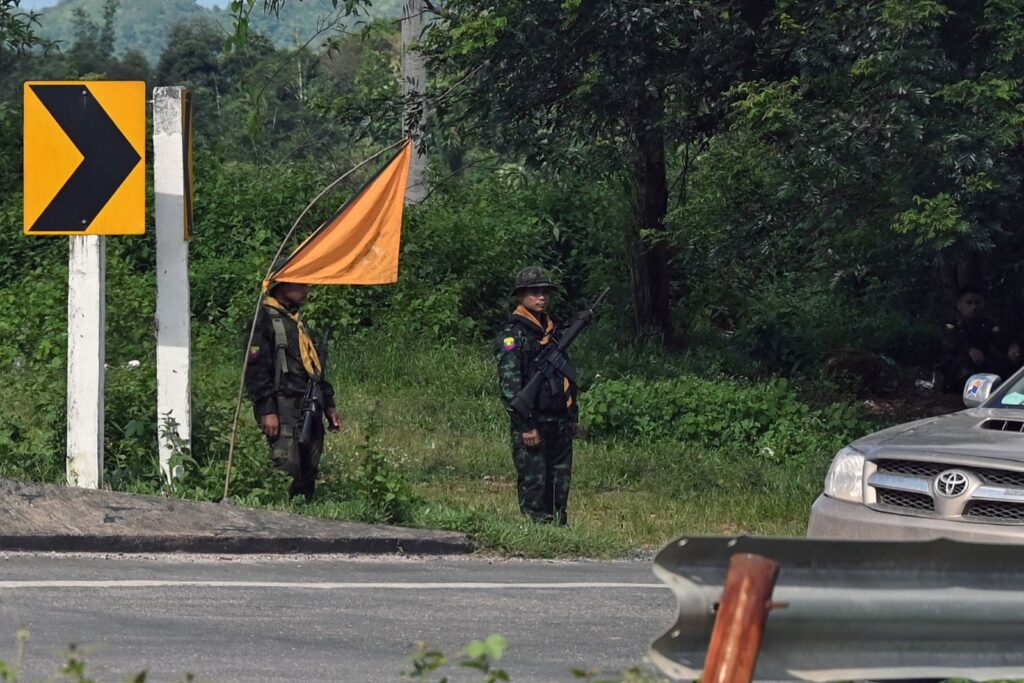
Asian Highway 1 is vital for Myanmar’s commerce with Thailand. The 45 kilometre section between the border town of Myawaddy and Kawkareik town in Kayin was blocked for extended periods after the February 2021 coup, due to intense fighting between the military and resistance forces led by the Karen National Union.
In June last year regime troops secured the highway and opened the blocked section. Businesspeople looked forward to trade returning to normalcy.
Their hopes were dashed in August last year, when the regime’s Foreign Exchange Management Committee banned the import of 35 types of goods – from tyres and flip-flops to coconut milk, instant noodles and soy sauce – in an ostensible effort to stabilise the kyat.
That month, junta chief Min Aung Hlaing ordered the tightening of imports through ports and border crossings, arguing that illegal trade was benefiting resistance groups and ethnic armed organisations.
Then, after Min Aung Hlaing was appointed president by the military-dominated parliament in April, the regime began an intensified crackdown on cross-border trade, including with Thailand.
The ensuing seizures and trade bans have been justified as measures to curb trade deficits and revenue loss, but they have also encouraged illegal trade and corruption. As a result, the population is suffering commodity shortages and soaring living costs.
“Prices have skyrocketed and goods are scarce,” Ko Aung Min, a cosmetics wholesaler in the Kayin capital Hpa-an, told Frontier, also using a pseudonym to protect his identity. “The working-class people at the bottom are in a pitiful state.”
He said a bottle of shower gel imported from Thailand used to cost K10,000 (US$2.1 at the market rate), but it has doubled to K20,000 since the crackdown began.
Aung Min added that as a result of the trade restrictions, Myanmar has returned to the era of the Burma Socialist Programme Party under General Ne Win, which lasted from 1962 to 1988.
“It’s hard to buy anything even if you have money. That’s what it has come to,” he said.
Importers in a bind
These restrictions have made life difficult for traders importing goods from Thailand.
Ko Min Min is a trader who uses the maritime route from Thailand’s Ranong province, as well as the land crossings in Myawaddy town and eastern Shan State’s Tachileik town.
“You have to pay bribes on all routes. You can only trade on those routes by paying,” he told Frontier, using a pseudonym.
He said trade from Thailand, already fraught with transportation hurdles, deteriorated further after Min Aung Hlaing was appointed president. Before, importers could easily bring goods into Myanmar by applying for an import licence or registering the commodities under the umbrella of “household items.”
“Now, instead of classifying them as household items, there are specific categories for every single imported item. This has caused massive headaches,” Min Min said.
Meanwhile, under its new, ostensibly civilian guise, the regime has refused to issue import licences, fuelling illegal cross-border trade.
According to Min Min, merchants must pay tolls to the KNU, the Democratic Karen Benevolent Army and the junta-aligned Kayin State Border Guard Force, as well as paying bribes at regime checkpoints along the roads. In eastern Shan they have to pay regime officials, while on maritime routes they must pay the junta’s navy.
Moe Gyi said driving a six-wheel truck from Payathonesu to Mawlamyine costs around K4.5 million in checkpoint fees, while driving a 12-wheel truck costs nearly K7 million.
To make the situation worse, even traders with import licences are facing seizure of their goods by the regime’s local administrators. Min Min said that in August several trucks carrying goods with valid import licences were intercepted at the entrance of Indu village, in Hpa-an Township.
“We brought items in with licences issued at the trade zone in Myawaddy, thinking our goods were legally imported,” Min Min said. “But once we got to Indu, they said, ‘It’s the regional commander’s order, so nothing is allowed through. Everything must be held.’”
“They made arrests, claiming that the commander had given verbal orders to seize the goods,” he said. “They make these sudden seizures out of the blue without any formal explanation.”
After the seizures, the regime’s trade task forces often auction the goods.
“We try our best to negotiate to buy our goods back before the auctions. If our seized goods are worth K100 million, we end up paying them another K100 million,” Min Min explained. “It amounts to paying double the value of the goods, and the local authorities pocket the money.”
“Sometimes negotiations don’t work because they claim it’s an official operation,” he added. “When that happens, we have to bid at the auction. You basically have to buy back your own property.”
These auctions have spawned a secondary market in which middlemen buy the goods and then ship them to major cities.
“It’s almost comical. Someone else imports the goods, there’s market demand and middlemen step in to place bids when the product is already halfway to its destination and buyers are waiting,” Min Min said.
He added that most of the middlemen operate in coordination with the local authorities.
To avoid these problems, importers are no longer transporting goods directly to major cities in large trucks. Instead, many of them are using multiple smaller vehicles to transport their cargo.
“We have to hire labourers and rent the vehicles when we offload and reload cargo on different trucks,” Min Min said.
All the expenses necessary to transport goods are added to their final price, driving up market prices, so the financial burden falls on the final consumers.
“We are running a business, so we have to factor in these operational costs,” Min Min said.
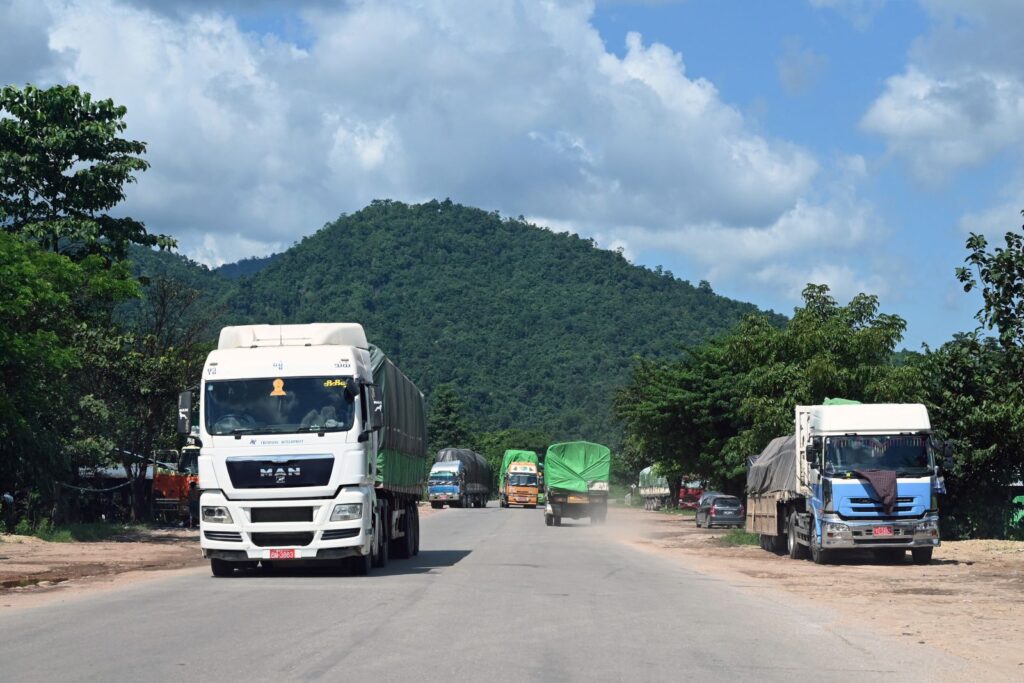
Empty markets
As a result of trade restrictions, some markets are virtually empty. That’s the case at the Lower Market in Mawlamyine, which used to bustle with buyers and traders selling goods imported from Thailand.
When Frontier visited the market in September, shoppers were scarce and Thai products were largely absent. “Goods from Thailand aren’t coming in,” one vendor said.
Many of the goods from Thailand that cannot be transported to major cities like Yangon pile up in Hpa-an town, which, as a result, has become a shopping destination for people from other parts of the country.
“People from all walks of life who live in big cities are coming down to our tiny town just to buy Thai goods,” Aung Min said.
Meanwhile, the trade situation has caused prices to increase across the country.
“Prices have gone up across the board,” said Ma Yamone, a resident of Yangon’s Sanchaung Township.
“A toothbrush that used to cost around K4,000 now costs around K20,000. But you can only get things when they’re in stock. More often than not, you go to shops and find nothing. It’s been months since we’ve seen items like Lipo or Red Bull.”
Import licensing restrictions are also affecting the production of domestic brands.
“Raw materials for locally manufactured instant noodles and food products are imported from abroad because there is nothing available locally,” said Ko Naing Lin, a senior manager at a Yangon-based food distribution company.
“We don’t have stock to distribute even when stores place orders with us. The orders are there, but the goods aren’t. Right now, whoever has inventory calls the shots,” he explained, using a pseudonym to protect his identity.
Ko Lin Htet, a retail shop owner in Yangon’s Mayangone Township, agreed.
“Now, when packs of bottled water run out it’s hard to replenish them. That’s because the chemicals used for water purification are imported from Thailand. Since roads are blocked and imports are halted, if I order 100 packs, they can only deliver about 20,” he said. “As for instant noodles, once stock runs out, ordering from the supplier is difficult. Everything is in short supply and it’s likely to get worse.”
Meanwhile, Min Min said the regime keeps running “enforcement campaigns” targeting imports, but it is consumers who pay the price.
“Traders have to pay bribes, but no merchant takes a loss out of their own pocket. If my costs go up by 200, I’ll sell it for a 250 markup. Those who need it will still buy it,” he said.
“Those who need to import will keep importing, and those running enforcement campaigns will keep running them. But in reality, the ones taking the hit are the consumers.”