POLITICAL INSIDER
This edition of Political Insider looks at the role of sports in post-coup Myanmar, from the use of medal-winning athletes in regime propaganda to decisions by players and fans to boycott the national team in protest against the junta.
By SWE HLAING HTOO and DOUGLAS LONG
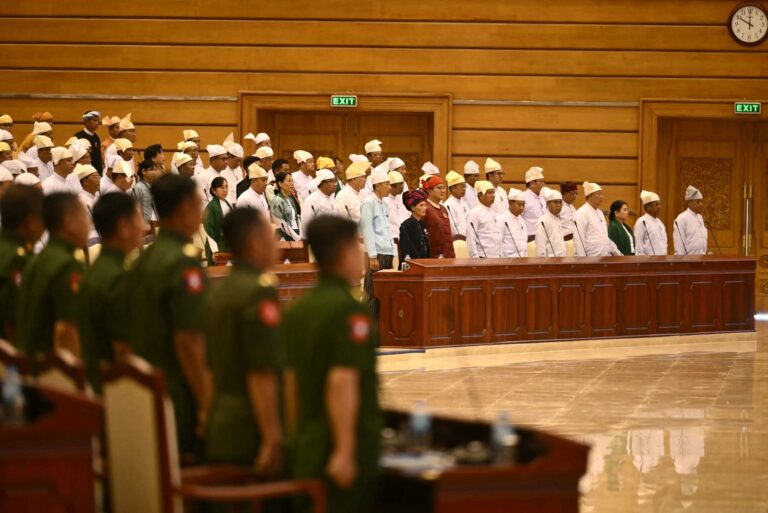
At a ceremony in Nay Pyi Taw on November 20 last year, aimed at “ensur[ing] success for the Myanmar sports contingent” at the 33rd Southeast Asia Games, junta chief Min Aung Hlaing evoked the rousing motto, “promoting sports is protecting the nation.”
He also exhorted athletes “to secure more medals than in the previous competition” and “to firmly keep in mind that achieving victory in every competition, in a manner that upholds the honour of Myanmar and all its citizens, is a national duty.”
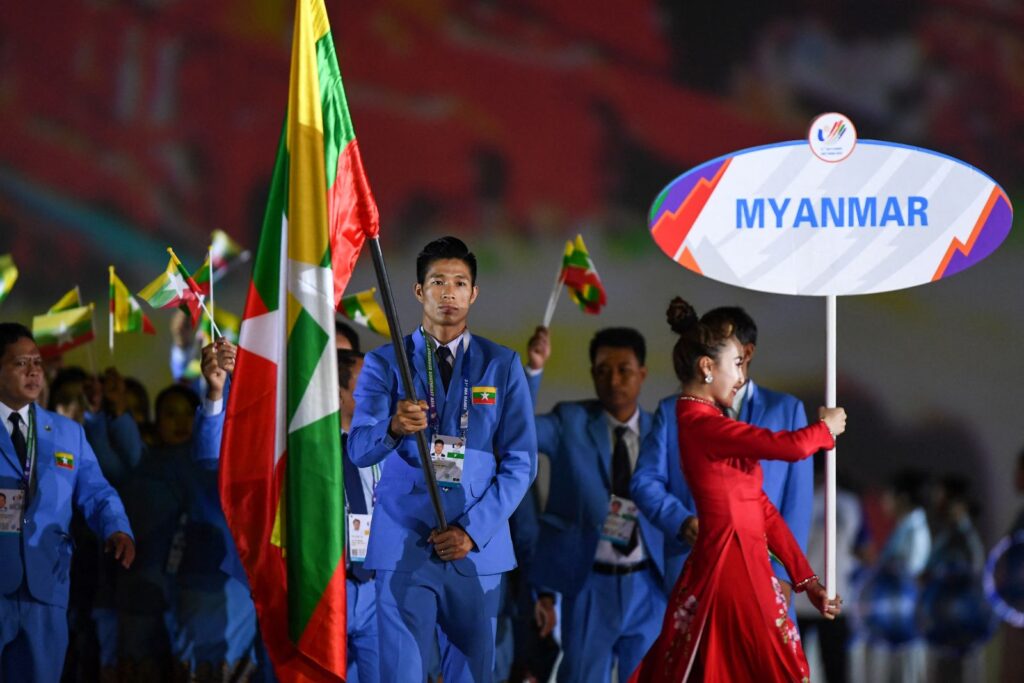
Throughout those SEA Games, held in Thailand from December 9 to 20, regime-run media published daily reports of Myanmar’s achievements. Alas, the country’s athletes failed to honour Min Aung Hlaing’s commandment to “secure more medals” – the final tally of 73 medals, including three golds, fell far short of the 114 medals, including 21 golds, won by Myanmar at the 2023 SEA Games in Cambodia.
However, dedicated consumers of state media would be unaware of this failure from reading The Global New Light of Myanmar, whose post-SEA Games assessment on December 23 highlighted the “past achievements” of the medal tally in Cambodia but made no mention of the lower count in Thailand.
In February, meanwhile, a ceremony was held in Nay Pyi Taw to recognise “Tatmadaw members and coaches who secured medals” at the SEA Games and other recent international competitions.
During the ceremony, Min Aung Hlaing said athletes “must possess a strong sense of responsibility to protect and safeguard the country.” He added that “only when such awareness is alive in the hearts of all citizens will it be possible to defend the nation against dangers that may seek to cause its deterioration and destruction.”
The use of sports for nationalist propaganda is nothing new. However, Myanmar sports writer and former athlete U TA told Political Insider that overtly aligning sports success with national defence, and “specifically honouring military athletes,” marks a shift in the tone of official propaganda since the February 2021 coup.
“Sports were utilised for nation-building and national identity in the post-independence era. Later, they were used for national prestige and international image,” said U TA, who has published numerous articles about Myanmar sports over the past 30 years. “Today, the connection of sports success with national prestige, patriotism, national duty, State prestige and even national defence has become much more explicit.”
Zun Moe Aung is a former professional footballer who played for the Myanmar national team in the 2010s. He quit the team after the coup, joined the Civil Disobedience Movement against the regime and eventually moved abroad.
“In our time, the government didn’t talk about defending the country or things like that,” Zun Moe Aung told Political Insider. “They only talked about increasing the nation’s glory by achieving success. They urged us to try harder for the nation.”
The regime’s heightened rhetoric about sports success safeguarding the nation against destruction is “just irrelevant lip service,” he added. “Nothing that comes out of Min Aung Hlaing’s mouth is useful or good.”
The role of athletes
U TA said ceremonies like the one held in February are more about “image-building” than developing sports in Myanmar.
He said genuine sports development requires support throughout an athlete’s career, not just when they win a medal. “You have to look at tangible results,” he said. “Are training facilities improving for the athletes? Are coaches receiving proper support? Is infrastructure being built for young people to play sports? Are athletes’ careers and welfare being protected? Looking at the current situation and past governments, real support for athletes has been rare.”
Myanmar’s sports ministry has long been obsessed with the immediate goal of earning medals at the SEA Games to the detriment of long-term development of athletes. According to sports physiologists, demanding events like competitive cycling at the international level require eight to 10 years of rigorous physical, psychological and skills training, starting as a teenager.
However, a former official from the Myanmar Cycling Federation, who asked not to be named, said cyclists are typically picked for the national team less than a year before each SEA Games. With such a short window of preparation, they are doomed to perform poorly.
Meanwhile, sports fans should distinguish between an athlete’s drive to compete and an endorsement of their government’s politics, U TA said. Although athletes competing in international events such as the SEA Games are seen as representing their countries, their participation does not necessarily imply support for their governments or policies. Medals won at such events are often seen as a source of national prestige.
However, U TA said that framing an individual athlete’s achievement as the success of their government is a different matter. “We need to separate ‘representing the nation’ from ‘supporting the ruling authorities.’ A nation is broader than a single government. An athlete can represent Myanmar without necessarily representing all of the government’s policies,” he said.
He added that while it is natural for an athlete to want to pursue their sporting career, in post-coup Myanmar sports can no longer be isolated from politics.
“Some athletes express their stance through the act of competing, while others express it through boycotting. Fans also express their views through giving or withholding support,” he said. “However, individual choices made by athletes should not be generalised – continuing to play doesn’t necessarily mean supporting the authorities, just as choosing not to play doesn’t imply that everyone shares the exact same motive.”
Many athletes are still willing to represent Myanmar in international competitions – the country sent 1,077 athletes to last year’s SEA Games – while others have refused to do so.
Myanmar swimmer Win Htet Oo qualified for the Tokyo Olympics, which were postponed from 2020 to 2021 due to the COVID-19 pandemic, but boycotted the event due to the coup. Footballers like Kyaw Zin Htet, Zaw Min Tun and Kyaw Ko Ko chose not to play for the national team in the 2021 World Cup qualifiers in defiance of the junta.
Goalkeeper Pyae Lyan Aung travelled to Japan with the national team in the same year to play in a World Cup qualifier, where he flashed the three-fingered salute as a protest against the coup. He refused to board the flight home and was later granted refugee status in Japan.
“Everyone wants to be a top player, but sacrificing that is nothing compared to what is happening in the country,” Pyae Lyan Aung told Agence France-Presse in 2023. “I can’t accept this unjust coup happening in Myanmar, and I think I did the right thing for a citizen to do.”
Zun Moe Aung told Political Insider that he had wanted to be a footballer since he was a child and spent many years working toward his dream, only to have his career cut short when he decided he could not play under the regime.
“I was in the peak age range of my career when the coup happened. I had years of experience and was at an age where I could still play. So in these past five years since the coup, I’ve lost my peak years as a player. Even if things become stable in Myanmar, I’ll never get those years back. I’ll have to switch to another life path,” he said.
“Of course I feel sad and emotional about it, but I have no regrets because I decided not to play under the military dictatorship. I feel that our sacrifices are nothing compared to the comrades fighting against the military council.”
Zun Moe Aung said he can count on his fingers the number of athletes who joined the CDM. After the coup, he posted a message on social media saying he would “not play football under the regime and would only return to the pitch when a free and fair government emerges.” Many of his national team friends shared the post, but when official football matches resumed, most of them went back to playing.
“I personally did not play under the military council. As for those who play, that’s their choice. I’d just like to ask them whether their conscience is clear,” Zun Moe Aung said.
Whether to participate or boycott can be seen as a way not only for athletes but also for fans to express their political views. This has been a fraught subject since the coup, with pro-resistance activists calling for condemnation and boycotts of celebrities who are perceived to support the junta, or who have refused to participate in the pro-democracy movement.
The first SEA Games following the coup were held in Vietnam in 2022, and although the regime sent a delegation, U TA said many Myanmar fans chose not to support the athletes as a gesture of opposition to the junta.
At last December’s SEA Games, Myanmar mixed martial arts fighter Vero Nika posted on Facebook photos of herself posing with members of the Myanmar team. The activist group FNCC Burma Fact Check Community posted on social media that she “lacked courage” by meeting with the athletes, who it insisted represented the junta. The post received thousands of likes, but other posts called for calm, saying Vero Nika had done nothing to harm the movement against the regime.
“We need to distinguish whether such boycotts are directed against the athletes or against the authorities,” U TA said. “A fan might refrain from offering support not out of animosity toward the athlete, but out of concern that the athlete’s success will be exploited by the authorities for political purposes.”
Tradition and internationalism
Of the three gold medals Myanmar won at last year’s SEA Games, two were in the traditional Myanmar sport of chinlone, which is not widely known outside Southeast Asia and has only been included in the SEA Games since 2013, when they were held in Myanmar.
A chinlone expert who spoke with Political Insider on condition of anonymity said chinlone dates back to the Sri Ksetra era, from the 5th and 7th centuries CE, and has been “passed down and played through generations.”
“In the past, it was not played as a sport. It was played purely for recreation – for beauty, fun and entertainment,” he said.
After Myanmar gained independence in 1948, however, it was tapped as an instrument to assert a new national identity. On one hand, scholars have noted, it was a continuation of indigenous culture that predated the colonial era. On the other, it provided the opportunity after independence to “develop a sporting infrastructure,” which was seen as a “metric of civility, cultural development and modernity.”
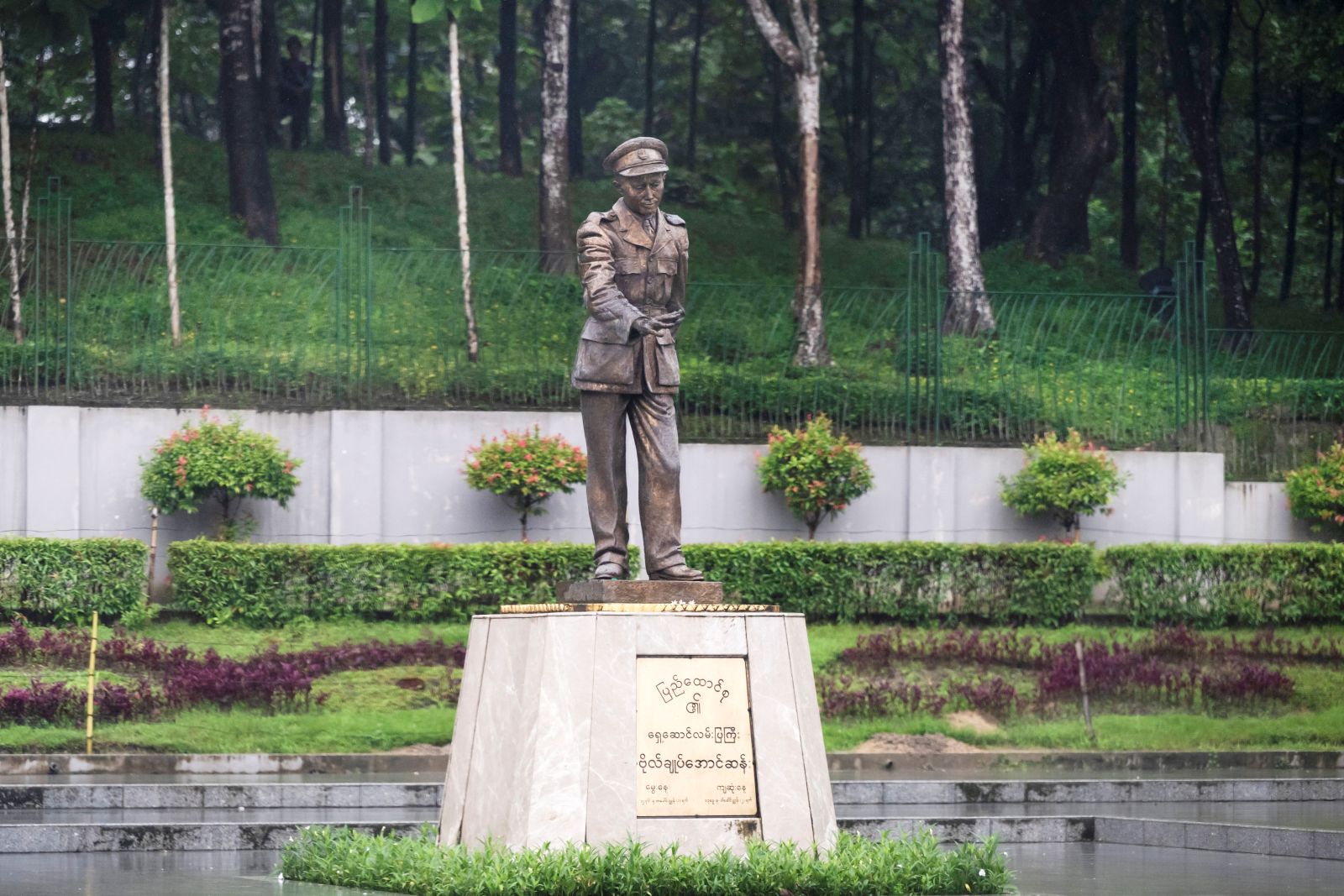
This development was accomplished in 1953 with the convening of the first Chinlone Conference in Yangon. Competitive rules were drafted, point systems were created and playing courts were standardised. The first national chinlone competition was held later that year at Aung San Stadium in Yangon.
That conference, scholar Maitrii Aung-Thwin noted, “completely altered the way in which chinlone would be conceptualized.”
“Rather than continue with the loose, informal format,” the conference delegates “sought to codify and authorize a set of rules, values, and procedures that would seemingly provide chinlone with the missing credentials that had prohibited it from being recognized as a ‘sport.’”
U TA said that in the 1950s and 1960s, sports were crucial for building the identity of a young nation, and the “modernisation” of chinlone as an activity that could be won or lost, rather than simply played for recreation, was a means to connect the past with the modern era.
“Chinlone became more than just a sport. It became associated with the idea of being ‘Myanmar’s own unique culture.’ Chinlone remains a clear example of sports being used to build a national identity,” he said.
The chinlone expert said around six ASEAN countries now “actively and enthusiastically” participate in chinlone competitions, which he was careful to differentiate from the sport of sepak takraw, which uses a similar cane ball but differs significantly in how it is played.
He said chinlone has seen little impact from the coup because “there is a vast number of players and anyone is ready for whatever competition comes up.” He added, however, that “hosting local festivals and shows domestically has become difficult” in Myanmar since the coup, resulting in a reduction in the number of chinlone events.
He said that in the case of chinlone, he thinks that sports and politics can be separated.
“There have been no boycotts or lack of supporters. We have not encountered such issues in our chinlone community,” he said. “Achievements have not been exploited for political purposes. The only thing is that due to politics, certain things we want to do in sports cannot be done or realised.”
Beyond the national teams
While Myanmar’s two chinlone golds gave fans something to cheer about at last year’s SEA Games, the question of whether to support or boycott national team athletes persists. In this atmosphere, those who wish to express their pride in Myanmar culture have found another outlet by supporting internationally known mixed martial arts fighters like Aung La N Sang and Joshua Van Bawi Thawng.
Joshua Van, whose fighting moniker is “The Fearless,” was born in Chin State’s Hakha town in 2001. His family emigrated to Malaysia when he was 10 years old, then moved to the United States in 2013, settling in Houston, Texas. He made his debut as a professional fighter in 2021 and became the Ultimate Fighting Championship’s first Asian-born male champion, often carrying a Myanmar flag into the ring and speaking proudly about representing his native country.
Last month, Joshua Van scored a well-publicised win over Brazilian Alexandre Pantoja, retaining his UFC flyweight title in the process. Myanmar fans took to social media in droves to express their pride.
“You are working so hard in sports to bring pride and honour to our beloved Myanmar,” one commenter posted on Facebook. “While some people are making our country a laughingstock on the world stage, you are making us proud through your dedication and achievements. The people of Myanmar who believe in the spirit of unity and solidarity among all ethnic groups are warmly celebrating and congratulating you on your success.”
After the fight, Mizzima published an editorial asserting that Joshua Van’s victories give Myanmar people a shared experience “to celebrate rather than mourn” at a time when “happiness can be difficult to find” in the country.
Analyst Sai Wansai went even further, claiming that Joshua Van’s fighting style, public persona and work ethic stand as a “metaphor for the Spring Revolution” against the regime.
“If a boy from Hakha can stand in the center of the world’s most popular fight organization and dominate the best in the world, then the youth of Myanmar can dominate the struggle for their own future,” Sai Wansai wrote. “Van proves that resilience is a skill, one that can be trained, honed, and weaponized against tyranny.”
The junta, meanwhile, has not shied away from attempting to claim the fighter as its own, describing him as “Myanmar representative Joshua Van” in state media reports. However, Zun Moe Aung told Political Insider that even though the flag that Joshua Van carries into the ring represents Myanmar, it has nothing to do with the regime.
“Van stands together with people like us and war refugees, but the military council tries to take credit by claiming, ‘He comes from our country, he is ours,’” Zun Moe Aung said.
“But Van didn’t achieve [his success] under their military clique. He had to leave Myanmar as a refugee because of them. Yet they try to hijack his credit. Only when he gained fame and success did they want to claim him as theirs.”
Zun Moe Aung, meanwhile, no longer plays football professionally, but contributes to the resistance by participating in fundraising drives and playing charity matches with other footballers. He said he and other CDM athletes still want to play for their country, but not under the military regime.
“We distinguish between the two. That’s why we joined the CDM,” he said.
“[The regime] will do whatever they need to do, but we will resist them to the very end. Once we pass through these times, I want to see sports and our country progress. As for [the regime], whenever they get the opportunity, they will use anyone and everyone for their survival – it’s not just sports that they are exploiting.”