Women in Myanmar’s central plains are unable to travel for work due to security concerns in the midst of civil war, and those who do work are struggling to support their families as they receive lower pay than men.
By ESTHER J | FRONTIER
Early one morning in July, a group of women gathered in Chaung U village, in Sagaing Region’s Tabayin Township. Some held torchlights in the pre-dawn gloom, while others carried bundles of rice seedlings as they headed to a field for planting.
When they arrived at the tract of muddy farmland, they hiked up their longyis to their knees and set about working – chatting, laughing and swapping jokes as they stooped and planted the seedlings.
It was a scene of rural calm. But beneath the talking and the laughter, there lurked anxiety and fear.
Before the February 2021 coup, central Myanmar remained largely untouched by the civil wars that have raged for decades in border areas. But after the military takeover, the junta responded to anti-coup demonstrations with violence, triggering an armed resistance movement that the regime has tried to quell by using scorched earth tactics against civilians.
The civil war soon spread to the country’s heartland – the central Dry Zone known as Anyar – placing an additional burden on women in a society dominated by men.
Before the coup, women in central Myanmar had more freedom to travel for work, but now they face shrinking opportunities and are confined to their villages due to security concerns.
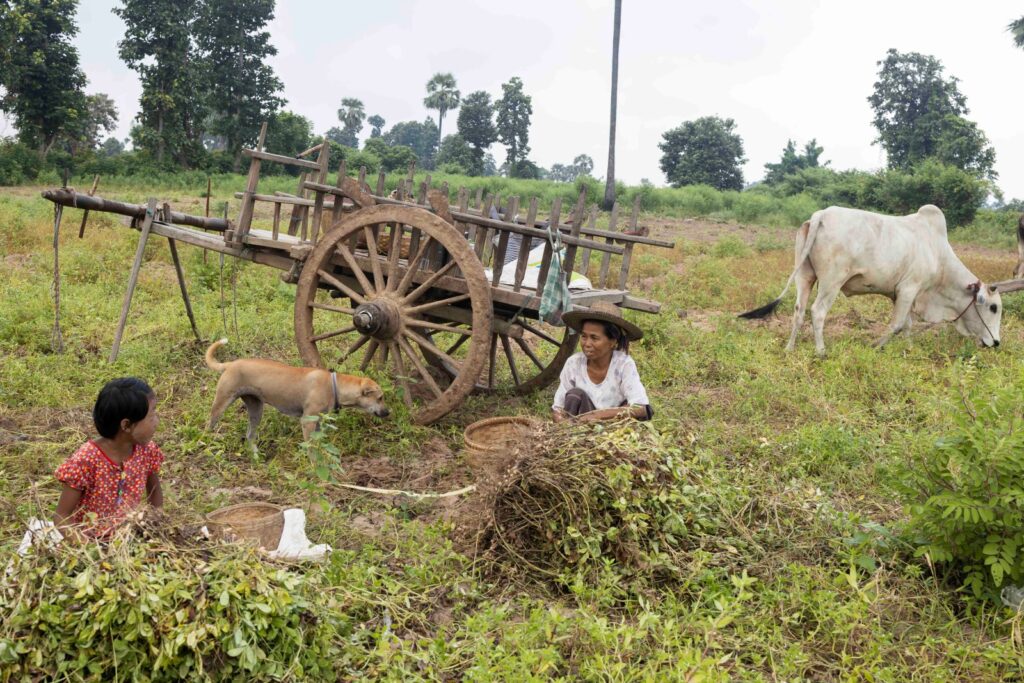
“We can’t go anywhere,” said Daw Ma Shwe, a 49-year-old woman from Tabayin, as she worked in the field. Her husband died 10 years ago, and she now lives with the younger of her two daughters.
“If there’s work in the village, we have to do it or we’ll stay jobless and spend our time sitting at home,” she said. “It’s not easy for us to work outside our village. We’re afraid to travel.”
Despite this, she is happy for the opportunity to work, whether planting rice in July or harvesting peanuts in September.
Tabayin, like many other parts of Anyar, is contested territory, with no government forces or resistance groups in full control. Villagers must therefore take responsibility for their own security. Many men are prepared to travel for work, but women are increasingly at risk of sexual violence as the conflict continues.
Last year, Tom Andrews, the United Nations special rapporteur on the situation of human rights in Myanmar, reported that the coup entailed a devastating setback for women and girls in the country, leaving them acutely vulnerable to discrimination, violence and exploitation.
The Women’s League of Burma, a human rights organisation, said in a report in June that sexual violence is on the rise, with “the military junta being the primary perpetrator”. The group said the “human rights situation has significantly deteriorated leading to a shrinking environment for women and girls to live safely and peacefully”.
Both the UN and Human Rights Watch have documented severe abuses by military forces against women and girls, including gang rape, sexualised torture and forced nudity. Light Infantry Division 99, known in Sagaing as the Ogre Column, is particularly notorious for abducting, beheading, maiming and raping women. These atrocities often occur at checkpoints or during raids.
Such abuses are not confined to the regime. In June, a pregnant woman was raped by the commander of a People’s Defence Force – armed groups established after the coup to fight the junta – in Sagaing’s Yinmabin Township. Last month, a 12-year-old girl was raped by a member of another resistance group in Sagaing’s Wetlet Township.
This catalogue of abuses has instilled deep fear among women in Anyar. As a result, their worlds have been reduced to their villages.
As elsewhere in Myanmar, traditional roles of men and women are clearly defined in Anyar, with women generally regarded as second-class citizens. They are normally limited to customary roles such as household duties, with men acting as the patriarchal heads of families.
There is even a Bamar proverb that normalises domestic violence: “If a man beats a woman until breaking the bone, he will be deeply loved.” Women throughout Myanmar also face numerous social restrictions, including being barred from some areas of religious sites.
Women are also employed for lower pay than men, working at casual jobs on the land, helping to sow and harvest crops like rice, beans, onions and peanuts. They earn a daily wage of K4,500 [about US$1.1 at the market rate] for this kind of work, compared to K10,000 for men. Meanwhile, men have traditionally had more job opportunities outside their villages, often at the gold mines and oil extraction sites that dot the Anyar landscape, for which they can earn up to K1 million per month.
‘Our lives were better’
The shrinking of opportunities for women since the coup is having a devastating impact on families. Ma Shwe remembers the days when she was able to travel throughout the country for jobs, whether as a farm worker, cook or domestic helper.
“Before the coup, our lives were better because travelling was easy,” she said. “Now, we can only earn just enough to eat. We don’t have any extra possessions. We’re living from hand to mouth.”
For most women in Tabayin’s rural areas there is no full-time work, and jobs come with the seasons. During the monsoon, which usually lasts from May to October, women plant peanuts. In July, the rice seedlings are planted. In late August and early September, the peanut pods are dug up and picked from the roots.
With the arrival of the cool season around November, it’s harvest time for rice and pigeon peas. All of this work, with the exception of uprooting peanut plants, is done exclusively by women.
As a casual seasonal worker, Ma Shwe is fortunate to find work during the different crop cycles. In July, she earned K7,000 a day for planting rice seedlings. During last year’s harvest season, women were paid K6,000 a day for cutting rice and K5,000 for picking pigeon peas.
This year, Ma Shwe and her 17-year-old daughter, Ma Ei Soe, picked peanuts for 20 days, for which they received one-eighth of the total amount collected in kind. This amounted to four sacks of peanuts, which can yield about 18 litres of edible oil.
This amount of oil could be sold for about K180,000, meaning that Ma Shwe and Ei Soe would each average K4,500 a day for their 20 days of work – well below Myanmar’s minimum wage of K6,800 for an eight-hour day.
“We earn very little,” Ma Shwe said. “We only get peanuts to make cooking oil for our kitchen. If we do this, we don’t have to buy cooking oil for the whole year.”
Besides farmwork, women can also earn money by weaving – the catch being that they first need to bear the costs of buying their own weaving looms and attending training.
Ei Soe began weaving two years ago, after dropping out of school to support her family. She can work all year, weaving cotton used in brightly coloured traditional Kachin textiles. Buyers collect the fabrics from weavers and sell them in Seik Kun village, in Sagaing’s Shwebo Township, a centre of traditional weaving.
Ei Soe takes seven days to weave a piece, earning the equivalent of K5,700 a day in the rainy season, when the fabric price is low, and sometimes up to K7,800 a day when prices are higher. A single piece of fabric can sell for K140,000 by the time it gets to a shop in Yangon.
Ei Soe’s earnings are her family’s main income, but small luxuries like body lotion are no longer an option, Ei Soe said. She added that she can only afford about one hour a month at the internet shop where resistance forces have offered Starlink access since the junta cut off internet service in her area.
On top of the daily struggle to survive, Ma Shwe and Ei Soe ran up a debt of K900,000, with monthly interest of five percent, when Ei Soe was hospitalised for an appendectomy. With the pressure of debt, Ei Soe is now thinking of joining the thousands of young Myanmar people who have left to work abroad since the coup.

‘Everyone must have equal rights’
On farms in Tabayin, men earn K20,000 a day for uprooting peanut plants, a job that women rarely do. Men are also employed as carpenters and bricklayers, and in car and motorcycle repair workshops, earning much more than female farm workers.
In the midst of this disparity, Daw Chaw Su Han, a women’s rights activist in Sagaing, is campaigning for equal pay.
“Some people say men are physically stronger and have to handle more workload,” she said. “There are also questions like, ‘Are women capable of doing men’s jobs?’ These are the kind of things we often hear, but I tell people we’re moving toward a country with equality, so everyone must have equal rights, including gender equality.”
Chaw Su Han described how, in a group of internally displaced people doing road repairs, men were paid K8,000 a day and women just K5,000. The bosses said the men were paid more because their work was more demanding.
“They said that men have to handle hoes and crowbars, while women just carry paving stones and soil in baskets,” she said. “Men get paid more than women with the justification that they are physically stronger.”
Some women interviewed by Frontier agreed that it makes sense for men to be paid more for doing harder physical work.
“They have to put in more physical effort than women. It’s tiring,” said Daw Phyu Phyu Win, a 40-year-old widow from a village in Sagaing’s Salingyi Township who works picking leaves at a betel plantation.
“Women only pluck the leaves and tie vines. It isn’t as tiring as the men’s work. Men set up poles for betel leaf gardens and spread fill soil for the plants. They have to use their strength,” she said.
She added that it’s also hard for women to get better pay because there are many women desperate for work and only a limited number of jobs available for them, whereas there is a shortage of men for jobs traditionally done by male workers.

Women left behind
Many men in Anyar have taken up arms to fight the regime, leaving women to fulfil the role of household head. Although there are women in the resistance movement, most serve in supporting roles, and very few are in decision-making positions.
Phyu Phyu Win’s husband was killed in a military raid near their village in late 2021. As a widow, she is raising her seven-year-old son alone, and it has become much harder to make ends meet.
“It’s a huge difference” without her husband, she said.
“We used to be able to buy enough rice for the whole year and cooking oil for a month,” she said. “Now, I can only afford to buy half a bag of rice and just an eighth of a litre of cooking oil at a time. I have to think very carefully about buying an egg or two.”
She added that she could not afford to buy her son a school backpack, and she’s now K300,000 in debt to friends for food and other daily expenses.
Phyu Phyu Win was paid K3,500 a day during last year’s picking season, but daily wages increased to K5,000 in March. This was because a military raid on villages near Letpadaung copper mine caused people to flee, resulting in a shortage of workers at the betel plantation.
Yet there are still more women available for work than men, making it more difficult for women to demand a significant pay increase.
“We don’t have the ability to negotiate higher wages like men do. The demand for female workers is low because there are so many more of us and men have more opportunities,” said Phyu Phyu Win. “This is just the norm in our villages.”
Women’s rights activist Chaw Su Hann said a handful of activists are not going to change things, and it is up to women to stand up and demand equality.
“We women need to fight for our rights,” she said.
But Ma Shwe is resigned to the wage gap. She sees it as traditional rather than discriminatory, but she would also like to earn better wages to help cover rising prices.
However, she’s not going to demand more pay anytime soon. The main problem, she said, is the shrinking job opportunities because of the civil war.
“Before, I could buy whatever I needed on the way home from work. I had money. Now I don’t get the good jobs anymore and we have to be very careful with our money,” she said.
“What I hope is for brighter days to come as soon as possible, and for all these atrocities [from the civil war] to come to an end. That’s what I keep praying for.”