Tens of thousands of migrant workers in Thailand are anxiously waiting to return to Myanmar, where capacity to safely quarantine arrivals has transformed since the chaotic returns of March.
By HEIN THAR and BEN DUNANT | FRONTIER
When State Counsellor Daw Aung San Suu Kyi held a video conference with the chief ministers of Kayin and Mon states and Tanintharyi Region on May 5, one topic dominated the virtual meeting: the imminent return of tens of thousands more migrant workers from Thailand.
Reminded of the mass return of migrants in late March, which devolved into chaos and sparked panic, they took turns to repeat the same phrase: “Don’t let it be like the last time.”
Thailand hosts an estimated three to four million workers from Myanmar, who process seafood, sew garments and toil on construction sites across the country. When factories and other workplaces in Thailand began closing or shedding staff because of the coronavirus pandemic, tens of thousands faced a desperate future in the country. Unable to find other work or access state benefits, and with their savings disappearing on lodgings and utility bills, many decided to take the overland trip back to Myanmar, unsure of when they could return.
In late March, more than 40,000 migrant workers crossed into Myanmar via the border town of Myawaddy in Kayin State, across the Thaung Yin (or Moei) River from Thailand’s Mae Sot. The Myanmar government was seemingly unprepared for the sudden influx of migrants from a country with a higher reported incidence of COVID-19. Overcrowded waiting areas at the border gate descended into melee, migrants shared buses with other passengers headed to Yangon, and local authorities struggled to enforce orders for migrants to quarantine for two weeks at home once they were back in their towns and villages.
This fiasco prompted the Minister of Health and Sports Dr Myint Htwe to warn of the potential for a massive outbreak of COVID-19 in Myanmar, and migrants were widely scapegoated by the public as ill-disciplined disease carriers.
Though Thailand formally closed its borders on March 23, thousands of migrant workers were still able to cross in the following week. But at the start of April, the Myanmar government announced that all remaining migrants in Thailand who wished to return had to wait until April 15, and this was later extended to the end of the month. Thailand’s state of emergency, in effect since March 26, allowed the government to impose restrictions on movement, and many migrants who wished to return home were unable to reach the border anyway.
‘Some can’t survive for all of May’
As May approached, Myanmar began preparing for large-scale returns. On April 30, state media quoted the Myanmar labour attaché in Thailand as saying that 16,324 migrants had registered with the embassy to return, and that the group included 202 “illegal” migrants and 472 who were “without documents”. However, civil society activists who assist Myanmar migrants in Thailand estimated that tens of thousands more wanted to return, but had not filled out the online form. Activist Ko San Linn Aung, who liaises regularly with the embassy on behalf of migrants, told Frontier he believed the true figure was closer to 70,000.
But then Thailand decided to extend its state of emergency for another month, to the end of May. This preserved the restrictions on travel between provinces, for which medical certificates and permission letters are often required, as well as the suspension of the state highway bus network. For most, getting to the border remains impossible.
So the first two weeks of May passed with only a thin trickle of returnees. Myawaddy Distrct Administrator U Tayzar Aung told Frontier that by May 13, only 396 people had crossed the border. Of these, Tayzar Aung said that about 200 returnees who are mostly local to Myawaddy are now in quarantine centres in the border town, with the remainder having been sent to their home states or regions to quarantine there.
While Thailand’s restrictions persist, the large majority of migrants scattered across the country face an anxious wait. Ko Hla Wai Soe, who has been stuck in the northern Thai city of Chiang Mai since work on construction sites dried up at the end of March, told Frontier on May 8, “We want to go back home so much, but the Thai government won’t allow us yet. Even their own citizens have difficulty going from one district to another.”
Migrant assistance organisations in Thailand told Frontier that they were focusing on providing food parcels to Myanmar migrants, many of whom have gone into debt just to pay for essentials. “People want to return to Myanmar to save money,” said Mr Johny Adhikari, founder of the Metta Charity, which works in Mae Sot and Chiang Mai. “They don’t want the pressure of paying rent and utilities while they’re out of work.”
U Htoo Chit, executive director of the Foundation for Education and Development, who lives in Phang Nga in southern Thailand, said he was getting calls around the clock from distressed Myanmar workers now out of a job. “Some can’t survive for all of May,” he said. “Others fear they can’t even survive for five more days.”
Reflecting the growing hardship, Myawaddy administrator Tayzar Aung said the number of migrants who had registered with the Myanmar embassy in Thailand to return had increased to 28,910 by May 13.
The embassy says it is negotiating with the Thai government to allow migrants to travel to the border at Mae Sot, and potentially other official crossings. In a May 14 announcement, it said it had requested Thai authorities to permit “2,500 or a suitable number of Myanmar workers to be able to travel to Myanmar border-gates daily” while the state of emergency is still in effect. The figure of 2,500 matches the capacity of Myanmar immigration and health authorities to admit and screen returnees at the No 2 Thai-Myanmar Friendship Bridge between Mae Sot and Myawaddy.
The announcement said the embassy had proposed that migrants also be allowed to exit Thailand at Ranong, opposite Kawthaung in southern Tanintharyi Region, and Mae Sai, opposite Tachileik in eastern Shan State, to make it easier for those in southern and northern Thailand. However, the Mae Sot crossing remains the focus, with the embassy requesting migrants be allowed to board buses at Bangkok for the border, preferably with an evening departure so they would arrive at Mae Sot in the morning.
However, the announcement did not say when the returns could happen, only that updates would given to migrants who had registered with the embassy.
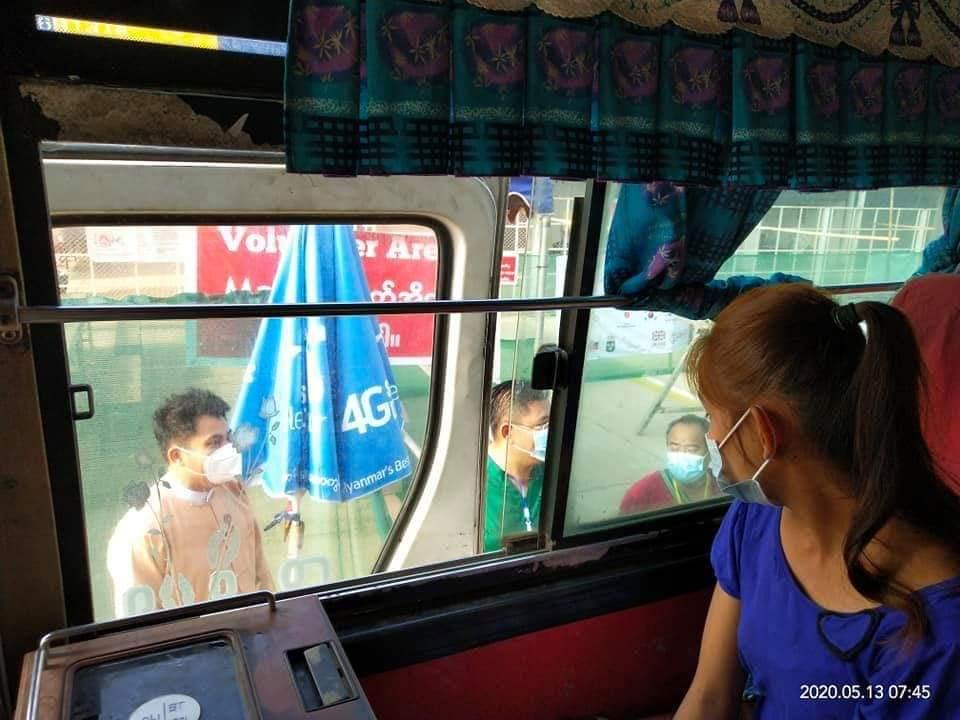
A returning migrant worker looks out from a bus at Myawaddy bound for Bago Region, where she will undergo 21 days’ quarantine, on May 13. (Supplied)